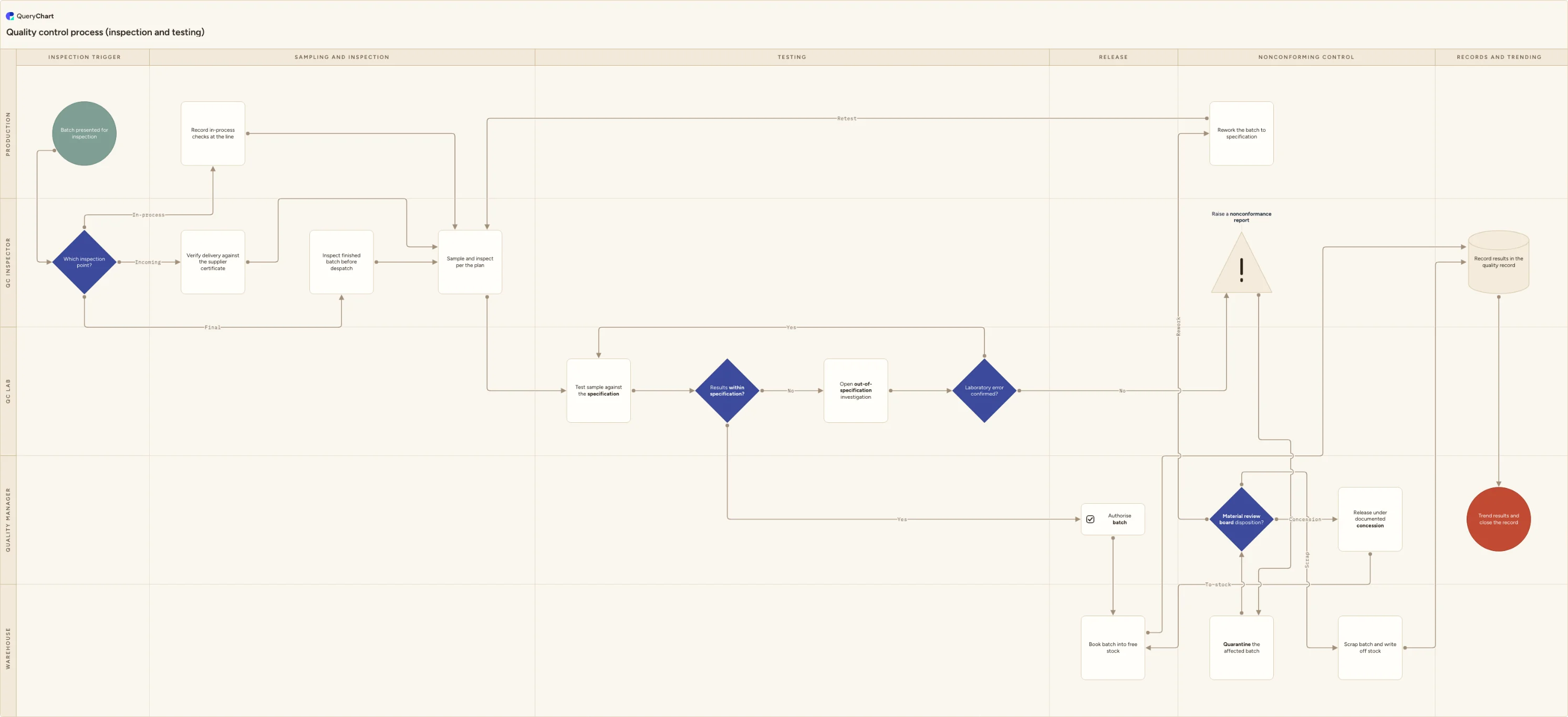
Quality control process flowchart
Quality control process flowchart: sampling per plan, incoming, in-process and final inspection, testing against specification, and nonconforming control.
What the quality control process is
Quality control is the part of a quality system that decides whether a specific batch conforms. Someone draws a sample to a defined plan, inspects it against the drawing or specification, tests what cannot be judged by eye, and then makes a call: release it, or hold it. Everything else in the process exists to make that call defensible: which sampling plan was applied, which specification revision the batch was tested to, which method produced the number, and where the record now sits.
The half that most process maps leave out is what happens after a fail. A single out-of-specification result is not a rejected batch; it is the trigger for an investigation that first asks whether the laboratory produced a valid number at all. Only once laboratory error has been ruled out does the material become a nonconformance: reported, quarantined so it cannot be picked by mistake, and taken to a review board that chooses between rework, acceptance under concession, and scrap. A chart that ends the failure path at a single reject box is how held stock quietly finds its way back into the picking face.
This template runs the whole route across five lanes (Production, QC inspector, QC lab, Quality manager and Warehouse) and six phases, from a batch arriving at an inspection point to results being trended and the record closed. It covers the three inspection points that are usually documented separately (incoming, in-process and final), the specification decision, the out-of-specification investigation, the three-way review board disposition, and the retest loop that sends a reworked batch back through sampling rather than straight to release.
What this flowchart covers
In this template
- Five swimlanes (Production, QC inspector, QC lab, Quality manager and Warehouse) across six phases: Inspection trigger, Sampling and inspection, Testing, Release, Nonconforming control, and Records and trending.
- A Which inspection point? decision that routes incoming deliveries to a check against the supplier certificate, in-process work to line checks recorded by Production, and finished batches to a pre-despatch inspection, with all three converging on one sampling step.
- Sampling and inspection to a stated plan, then testing of the sample against the specification in the QC lab, gated by the Results within specification? decision.
- The pass route: the quality manager authorises batch release and the warehouse books the batch into free stock, before the result is recorded.
- The out-of-specification trigger: a failing result opens an investigation and a Laboratory error confirmed? decision that either returns the sample for retest or confirms the result and raises a nonconformance report.
- Nonconforming material control: nonconformance report, physical quarantine, and a material review board disposition branching three ways into rework (which loops back through sampling for retest), release under documented concession, and scrap and write-off, all ending in the recorded and trended quality record.
When to use this template
- You are writing or revising an inspection and test SOP and need one picture showing where the sampling plan, the specification and the release decision actually sit.
- Held or failing material keeps reappearing in usable stock, and you need to see whether quarantine, disposition or the retest loop is what breaks down.
- Out-of-specification results are argued case by case, with no agreed route from a failing number to a retest, an investigation or a nonconformance.
- You are preparing for an ISO 9001 or customer audit and need the control of nonconforming outputs route documented, including who may authorise a concession.
- Results are recorded but never trended, so the same defect, supplier or line keeps producing failures that nobody aggregates.
How it works
Name your real inspection points
Replace the Incoming, In-process and Final branches with the points you actually operate — goods-in, first-off, patrol, final, pre-despatch — and give each one its own specification and reaction plan. If you only inspect at goods-in, delete the other branches rather than leaving undrawn steps that people assume happen.
Attach the real sampling plan
Record the standard, AQL, inspection level, lot size and the accept and reject numbers on the sampling step, plus what switches you to tightened or reduced inspection. ISO 2859-1 or ANSI/ASQ Z1.4 cover attribute sampling; state 100 percent inspection explicitly where that is what you do.
Put the specification and method on the test step
Name the specification and its revision, the approved test method, and who is competent to run it. A test step that does not record which revision applied is the step that fails an investigation two months later.
Write your out-of-specification rules into the branch
Decide who may invalidate a result, how many retests are permitted and on which sample, and what evidence closes the laboratory phase. Without those written down, the retest loop turns into testing until a passing number appears.
Name the review board and its authority
List who sits on the material review board, who may authorise a concession, and when the customer has to be told before nonconforming product is accepted. Add a value or risk threshold if the board only convenes above one.
Decide what gets trended, and where it is reviewed
Pick the fields the trend needs — defect code, supplier, line, shift, batch — and name the forum that looks at them. Recording results with no review step means the process ends in a filing cabinet rather than in a corrective action.
Frequently asked questions
What are the steps in a quality control process?
Seven, in this order: identify which inspection point applies (incoming, in-process or final); draw a sample per the sampling plan; inspect it; test it against the specification; decide whether the results conform; release the batch or route it into nonconforming control; and record the results so they can be trended. The decision in the middle is the process. Everything before it exists to make that decision reliable, and everything after it exists to make it traceable.
What is the difference between quality control and quality assurance?
Quality control is product-facing and after the fact: it inspects and tests output and decides whether this batch conforms. Quality assurance is system-facing and preventive: procedures, training, supplier approval, calibration, validation and audit, all aimed at making conformance likely in the first place. In this chart the QC inspector and QC lab lanes are quality control; the quality manager's release authorisation, review board and trending steps are where control feeds back into assurance.
What happens when a test result is out of specification?
It triggers an investigation, not an immediate rejection. The first phase looks at the laboratory — method, dilution, calculation, instrument, analyst — because an invalid number should not condemn conforming product. The original result stays on file whatever is found, and retesting happens under a written plan rather than repeatedly until a passing number appears. If no laboratory error is found, the result stands and the batch becomes a nonconformance: reported, quarantined and taken to the review board. Regulated manufacturers formalise this split (the FDA's out-of-specification guidance separates a laboratory phase from a full investigation), but the logic holds in any factory.
What is the difference between rework, concession and scrap?
They are the three dispositions a material review board can give nonconforming material. Rework brings it back into full conformance and has to be re-inspected and retested — in this chart the rework branch loops back to the sampling step, never straight to release. A concession is documented acceptance of product that still does not meet the requirement; ISO 9001:2015 clause 8.7 calls this acceptance under concession and expects the authorising person and the record to be identified, with the customer informed where the requirement is theirs. Scrap disposes of the material and writes it off, with the reason recorded so the cost appears in the trend rather than disappearing into stock adjustments.
Where this process fits
In most operations this process follows New product introduction (NPI) process flowchart and hands off to Batch release process flowchart (QP certification to despatch).
It is one step in Nonconformance to CAPA.
Step 1: Quality control process flowchart You are here
Quality control process flowchart: sampling per plan, incoming, in-process and final inspection, testing against specification, and nonconforming control.
Step 2: Deviation management process flowchart
Deviation management process flowchart: detection, containment, classification, impact assessment, investigation, batch disposition, CAPA and closure.
Step 4: CAPA process flowchart (corrective and preventive action)
Step 5: Change control process flowchart