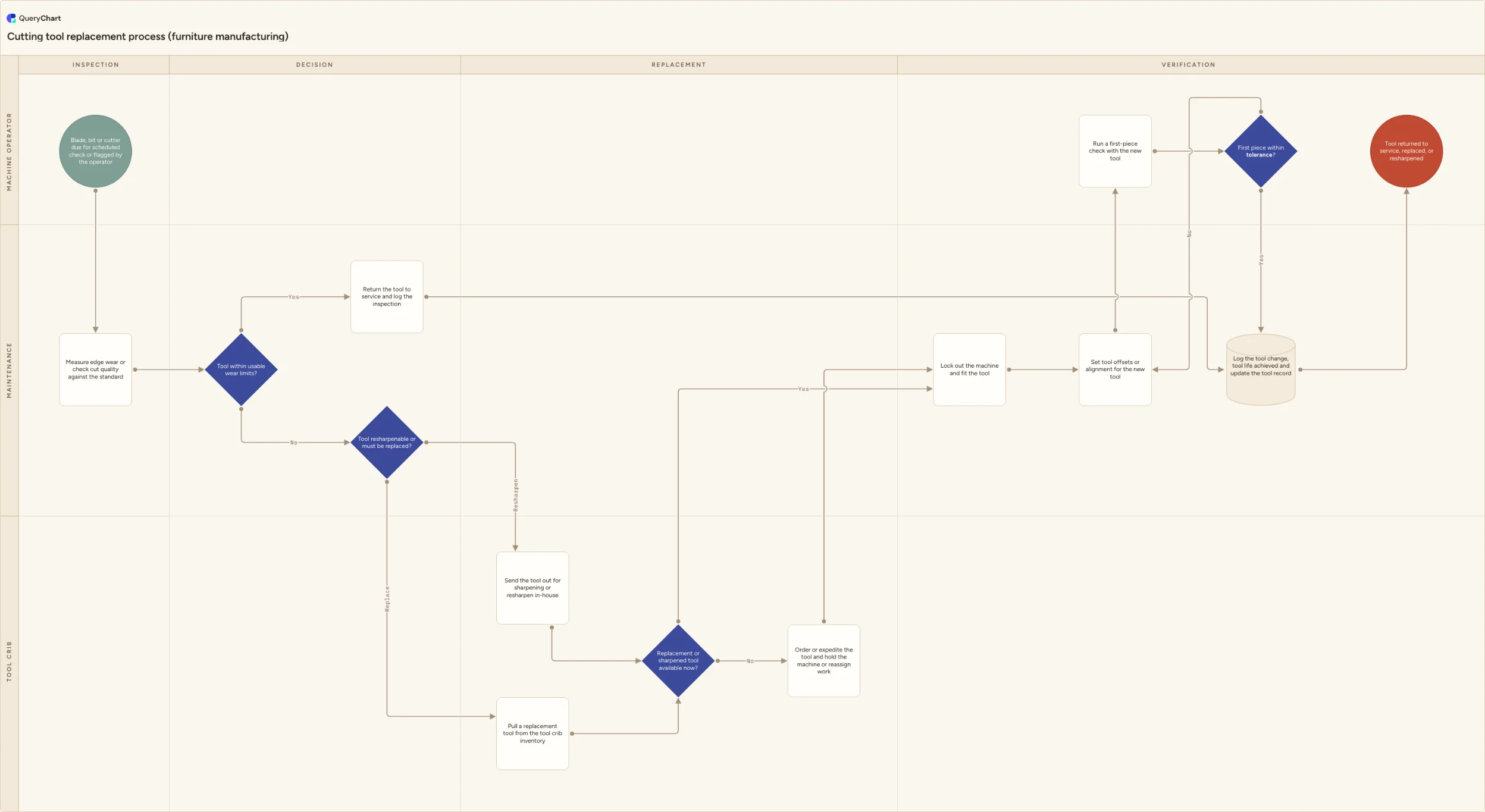
Cutting tool replacement process flowchart
A cutting tool replacement process flowchart covering wear inspection, a resharpen-versus-replace decision, tool crib availability, and a first-piece verification.
What the cutting tool replacement process is
Tool wear management across a whole fleet of machines is a different problem than checking one blade during one machine's maintenance — it needs an inventory system (the tool crib), a resharpen-versus-replace policy that applies consistently across every cutting tool in the shop, and tracking that reveals which tools are burning through their expected life faster than others.
The resharpen-versus-replace decision matters because not every worn tool is a candidate for both options — some tools are economical to resharpen repeatedly, others are cheaper to simply replace once worn, and a process that defaults to one or the other regardless of tool type wastes either money or usable tool life.
The process runs across four phases (inspection, decision, replacement and verification) and three lanes (Machine operator, Maintenance and Tool crib), with an availability check that can hold the machine or reassign work when neither a replacement nor a sharpened tool is immediately on hand, and a first-piece check after fitting that loops back to offset adjustment rather than assuming the new tool is correctly set on the first try.
What this flowchart covers
In this template
- Wear measurement or cut-quality assessment against a stated standard, rather than a subjective 'looks dull' judgment.
- A resharpen-versus-replace decision, recognizing that not every tool type is economical to sharpen repeatedly.
- A tool crib availability check with a hold-or-reassign path when neither a sharpened nor replacement tool is immediately ready.
- Tool offset and alignment setting as a distinct step after fitting, before any production output is trusted.
- A first-piece tolerance check with a loop back to offset adjustment, and tool life logged against the tool record for fleet-wide tracking.
When to use this template
- You manage cutting tools across multiple machines and need a documented process distinct from the tool-check embedded in individual machine maintenance.
- Resharpen-versus-replace decisions are made inconsistently between operators, without a stated policy for which tools warrant which option.
- Tool changes are happening without a documented first-piece check, risking production continuing on an incorrectly set new tool.
- You want tool life data tracked across the fleet to identify tools wearing faster than expected.
How it works
Measure wear against a stated standard, not a visual guess
"Measure edge wear or check cut quality against the standard" needs an actual measurement or comparison method, not a subjective sense that a blade seems dull based on how the last few cuts looked.
Set a real policy for resharpen versus replace
"Tool resharpenable or must be replaced?" should follow a stated policy per tool type — some tools are economical to resharpen repeatedly, others aren't worth the sharpening cost relative to a new one — rather than a case-by-case call.
Give unavailable-tool situations a real fallback
"Order or expedite the tool and hold the machine or reassign work" should specify which applies — whether the machine sits idle waiting, or the work is reassigned to another machine while the tool is sourced.
Verify with a first piece before trusting the new tool
"Run a first-piece check with the new tool" catches an offset or alignment error before a full run is produced against it. Loop back to adjustment, not straight to production, if the first piece isn't within tolerance.
Frequently asked questions
Why does tool management need its own dedicated process rather than being handled within each machine's maintenance?
Because tools move between the tool crib inventory, sharpening services, and multiple machines — managing that flow, plus tracking tool life across the whole fleet, needs its own inventory-aware process. Individual machine maintenance checks whether the currently fitted tool is usable; this process handles what happens across the entire tool supply once a tool needs attention.
How do you decide whether a worn tool should be resharpened or replaced?
Based on a stated policy specific to the tool type — some cutting tools (many carbide blades and bits) are economical to resharpen multiple times before they're truly spent, while others degrade in a way that makes replacement more cost-effective after the first wear cycle. The policy should be documented per tool type, not decided ad hoc each time a tool wears out.
What happens if no replacement or sharpened tool is available when needed?
The chart routes to ordering or expediting the tool while deciding whether to hold the machine idle or reassign its scheduled work elsewhere — which option makes sense depends on how urgent the work is and whether another machine can realistically absorb it.
Why does a new tool need a first-piece check before full production resumes?
Because fitting a new or resharpened tool can introduce an offset or alignment error that isn't obvious just from the tool being physically installed correctly. A first-piece check catches that before a full run is produced against an incorrectly set tool, which would otherwise mean scrapping or reworking every piece made until the error was discovered.
Where this process fits
In most operations this process follows CNC wood machining process flowchart.
Comes before
- CNC wood machining process flowchart — A CNC wood machining process flowchart covering program verification, workholding, tool condition checks, and a tolerance decision that separates tool wear from setup error.
- Woodworking machine maintenance process flowchart — A woodworking machine maintenance process flowchart covering belt and bearing inspection, blade sharpness, safety interlock checks, and a test-cut verification.