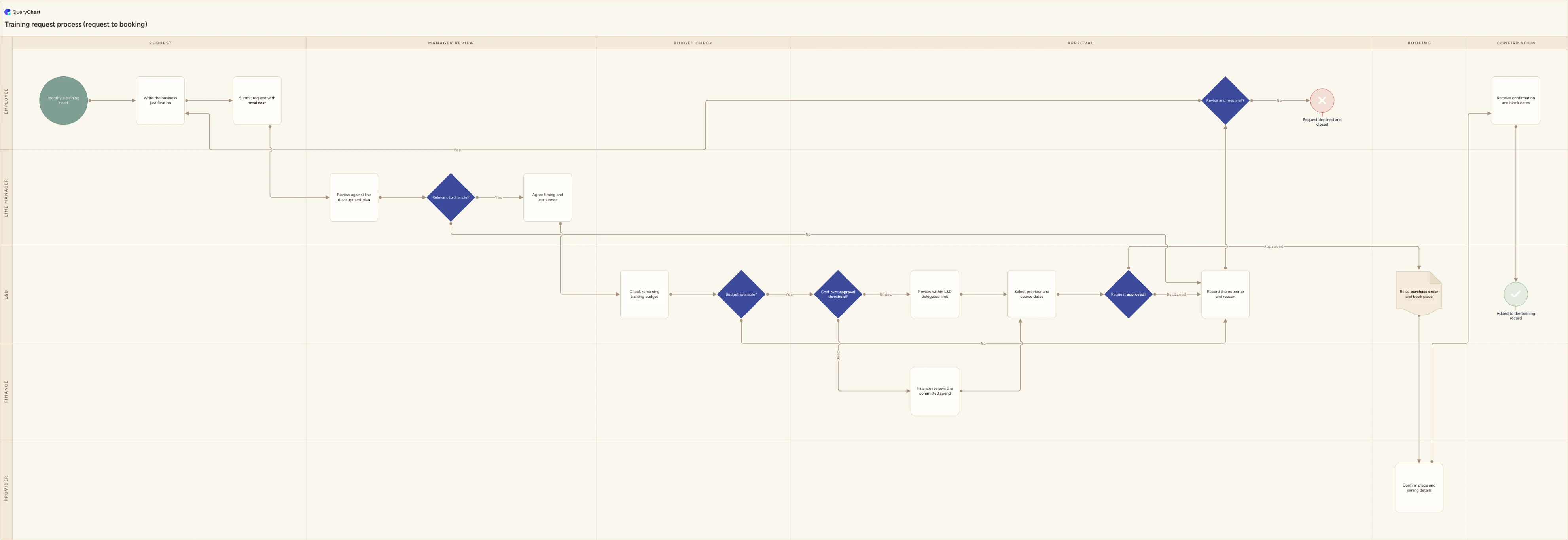
Training request process flowchart (request to booking)
Training request process flowchart: costed request, line manager relevance check, budget availability, threshold approval to L&D or finance, then booking.
What the training request process flowchart (request to booking) process is
A training request is an employee asking for training the organisation has not already assigned to them. It sits outside the annual training plan, and outside mandatory and role-entry training, both of which are scheduled by somebody else and simply appear in a diary. Because nobody budgeted for it in advance, a request has to earn its place: it needs a justification tied to the role, a full cost rather than a course fee, and someone with the delegated authority to commit the money.
This chart covers the request and approval stage only, from the moment an employee raises the idea to a confirmed booking and an entry in the training record. It stops there deliberately. What happens after the booking - attending, being assessed, evidencing competence and checking months later whether the training changed anything - belongs to the wider training process, which is mapped separately. A need identified by an appraisal, an audit finding or a change in regulation also enters elsewhere, through training needs analysis, because that need is confirmed by the organisation rather than proposed by the individual.
The chart runs across five lanes - Employee, Line manager, L&D, Finance and Provider - and six phases. It keeps the awkward routes visible rather than treating them as exceptions: a request that is not relevant to the role exits at the manager rather than after L&D has spent a week on it, a request with no budget left is recorded and closed instead of being left open indefinitely, and every refusal, at whatever stage it happened, is written to the same outcome record with a reason before the employee decides whether to revise and resubmit.
What this flowchart covers
In this template
- Five swimlanes (Employee, Line manager, L&D, Finance, Provider) across six phases: Request, Manager review, Budget check, Approval, Booking and Confirmation.
- A costed request up front: the employee writes the business justification, then submits the request with the total cost - travel, materials, exam fees and working days away - not the course fee on its own.
- A "Relevant to the role?" decision in the Line manager lane, followed by an explicit "Agree timing and team cover" step, so release of time is settled before anyone is asked to fund the request.
- A "Budget available?" check against the remaining training budget, whose "No" branch goes to the same outcome record as every other refusal rather than leaving the request open.
- A "Cost over approval threshold?" routing that sends smaller requests to a review within the L&D delegated limit and larger ones to Finance, with both routes rejoining at "Select provider and course dates" and a single "Request approved?" gate.
- The declined branch: "Record the outcome and reason", then a "Revise and resubmit?" decision that either returns the employee to the justification step or ends at "Request declined and closed". The approved branch raises a purchase order, the provider confirms the place and joining details, the employee blocks out the dates, and the request is added to the training record.
When to use this template
- Employees ask for courses by email, and nobody can say afterwards who approved what or what was spent on ad hoc training last year.
- You have an annual training plan and a training budget, but no defined route for the requests that arrive outside them.
- Managers and L&D disagree about who decides, particularly on cost and on releasing the time.
- You are configuring an LMS, HR system or intranet form, and the approval routing, threshold and required fields need to be agreed before anyone builds them.
- You need to show at review time that discretionary training spend was authorised by someone holding the delegated authority to commit it.
How it works
Rename the lanes to your real roles
Replace Employee, Line manager, L&D, Finance and Provider with the functions you actually have. In smaller organisations L&D sits inside HR and Finance is a single business partner; merge those lanes rather than drawing a handoff that never happens. Keep the Provider lane even for internal courses, because an internal trainer still has to confirm a place and a date.
Define what the request must carry
Set the fields at the submission step: course title, provider, dates, delivery mode, fee, travel and accommodation, exam or certification fees, working days away, and the capability the training develops. State whether the time away is charged to the team, because that is the cost managers argue about after approval rather than before it.
Make the budget check look at committed spend
"Budget available?" should test the remaining budget after places already reserved for later in the year, not only what has been invoiced. Reserved-but-unbilled places are the reason a training budget looks healthy in month six and is exhausted in month seven.
Set the approval threshold and write it down
Take the figure from your delegation of authority schedule, state the currency, and say whether it applies to the course fee or to the total cost. Also state who approves when the requester is themselves an approver, and who approves in their absence, so the routing does not quietly default to whoever is available.
Decide what "relevant to the role" means
Give the manager a test rather than a judgement call: does the training support an objective in the current development plan, a capability the role needs next, or a requirement of the role itself? Record which one applied, so refusals are consistent between managers and can be explained later.
Give every refusal a reason and a route
"Record the outcome and reason" should use a short list - not relevant, no budget, cost too high, timing - plus free text, and it should capture refusals from the manager and the budget check as well as from the approval gate. The resubmit decision should carry a date on which the request may be reconsidered, otherwise "not now" becomes "never".
Agree the booking terms, then version the map
Decide who raises the purchase order, what the provider's transfer and cancellation window is, who bears the cost of a no-show, and who tells L&D so the budget and the training record are both updated. Then approve and version the map in QueryChart, so the process people are trained on is the one you can point at later and amendments are tracked rather than circulated as new attachments.
Frequently asked questions
What is a training request process?
It is the route an employee-initiated request for training follows before any training happens: a justification and a full cost, a line manager check that the training is relevant to the role and that the time can be released, a check that budget remains, approval by whoever holds the authority for that value, selection of a provider and dates, then a booking, a purchase order and an entry in the training record. It exists because this training was not planned or assigned, so somebody has to decide whether the organisation will pay for it and release the time.
How is this different from the training process?
This chart is the front half only. It ends at a booked place and a training record entry. The wider training process starts from a need the organisation has identified - through training needs analysis, an appraisal cycle, an audit finding or a regulatory change - and continues past delivery into competence assessment, the training record and a later check that the training was effective. Use this template when the question is "should we fund and book this?"; use the training process template when the question is "how do we know the person is now competent?".
Who should approve a training request?
Two different approvals are involved and they are often confused. The line manager approves relevance and the release of time, because that is the cost the team carries. The budget holder approves the money, which in most organisations means L&D up to a stated limit and finance above it. Write the limit into your delegation of authority schedule rather than leaving it to habit, and name the approver on the record. Where an employee's manager is also the budget holder, state who approves instead, so nobody signs off their own team's spend without a second pair of eyes.
What should a training request form ask for?
Enough to decide without a follow-up email: the course, provider, dates and delivery mode; the total cost, meaning fee plus travel, accommodation, materials and any exam or certification fee; the working days away from the role; the capability being developed and which objective or role requirement it supports; and any cover arrangements needed. The field most often missing is the time cost, and it is the one that most often reopens an approved request.
What should happen when a training request is declined?
Record the outcome and the reason in the same place, whatever stage the refusal happened at, then give the employee an explicit decision about revising and resubmitting. In this chart a manager's "not relevant", an exhausted budget and a declined approval all converge on one record step and one "Revise and resubmit?" decision, which either sends the employee back to the justification or ends at "Request declined and closed". Refusals that are only ever communicated verbally are why the same request reappears twice a year and why nobody can explain what the organisation actually funds.
Does mapping this process satisfy ISO 9001 clause 7.2?
No, and it is not intended to. Clause 7.2 (Competence) is concerned with determining the competence needed, ensuring people are competent, acting where there is a gap, evaluating the effectiveness of that action, and retaining documented information as evidence. A request-and-approval flow contributes the approval record and the handover into the training record, but the competence evidence comes from the assessment and effectiveness steps that sit in the wider training process. Treat this chart as the funding and authorisation control, not as competence evidence.