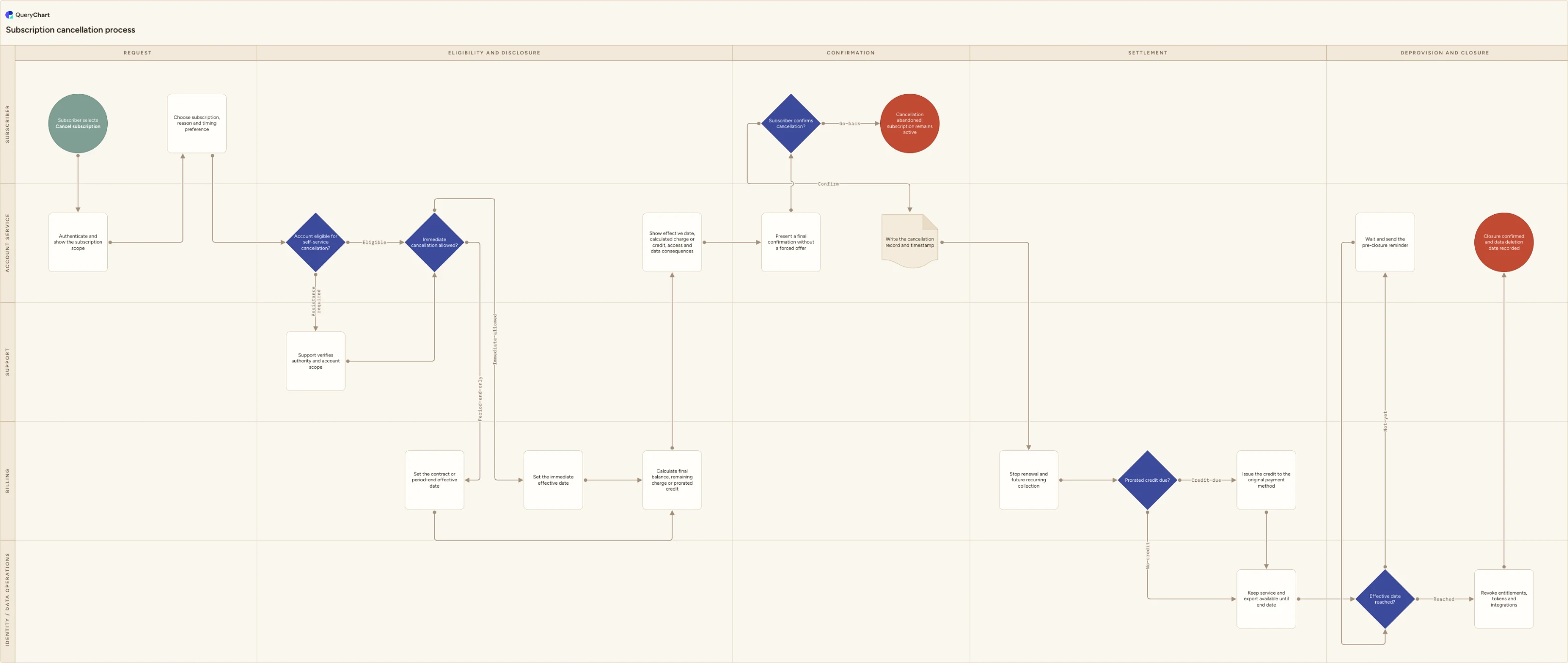
Subscription cancellation process flowchart (self-service to closure)
Subscription cancellation process template for a transparent self-service path: authority checks, effective-date disclosure, explicit confirmation, billing settlement, access expiry and closure evidence.
What the subscription cancellation process flowchart (self-service to closure) process is
This chart follows a subscriber from the cancel control to a closed account without hiding the action behind an agent conversation. The service authenticates the user, shows exactly which subscription is in scope, captures timing and a reason, and checks whether the account can be handled in self-service. Complex ownership or account structures go to support for verification but rejoin the same transparent path. Before confirmation, the subscriber sees whether cancellation is immediate or at period end, the expected final balance or credit, how long service and export remain available, and what happens to data.
This is narrower than the existing customer cancellation process, which covers agent-led retention, notice terms, involuntary churn and broader offboarding choices. Here the design problem is end-to-end execution of a voluntary subscription cancellation after the subscriber has chosen the control. There is no forced save offer. A subscriber who goes back keeps the subscription active; one who confirms receives a durable timestamp, renewal is stopped, any prorated credit is settled, entitlements remain available until the disclosed effective date, and tokens and integrations are revoked only then. The closing record contains both customer confirmation and the data-deletion date, which makes the process auditable without making it obstructive.
What this flowchart covers
In this template
- Five swimlanes across Request, Eligibility and disclosure, Confirmation, Settlement, and Deprovision and closure, including an assisted branch that rejoins self-service after authority verification
- A clear scope and eligibility check before confirmation, followed by disclosure of the effective date, charges, service access and data consequences
- An immediate-versus-period-end decision and a final confirmation screen that does not require a retention call or conceal the cancel action
- A timestamped cancellation record, renewal stop, final balance calculation and prorated-credit branch using the original payment method
- A real effective-date wait loop that keeps service and export available until closure, then revokes entitlements, tokens and integrations and records the deletion date
When to use this template
- You are designing or auditing the cancel flow for a SaaS product, membership or digital subscription and need product, billing and identity behavior agreed together
- Subscribers can submit a request online but staff still complete renewal stops, credits or access removal manually in disconnected systems
- Customers lose access on the request date even though the confirmation showed a later paid-through date, creating disputes and support work
- You need evidence of who confirmed, when renewal stopped, when entitlements ended and what deletion date was communicated
How it works
Define self-service eligibility
List the conditions that require assisted verification, such as an organization account with delegated billing, a disputed owner, a regulated retention hold or bundled subscriptions that cannot be separated. Keep the exception list narrow and route verified cases back into the same disclosure and confirmation path.
Write the disclosure contract
Specify the end date, remaining charges, possible credit, service availability, export window and data-deletion date that must be calculated before confirmation. Test the wording against immediate and period-end cases so the subscriber never has to infer when access ends.
Persist confirmation before side effects
Create the timestamped cancellation record before stopping renewal or changing entitlements. Include the authenticated actor, subscription scope, displayed effective date and policy version so support can reconstruct exactly what the subscriber confirmed.
Coordinate billing and identity clocks
Make the billing stop and entitlement end derive from the same effective date. Reconcile immediate cancellation, period-end closure and prorated credits in tests, and ensure retries cannot issue a second credit or leave recurring collection active.
Test abandonment and completion
Walk a subscriber who goes back, an eligible immediate cancellation, a period-end cancellation and an assisted account through the flow. Confirm that abandonment makes no changes and every completed path sends a receipt and records the deletion date.
Frequently asked questions
What are the steps in a self-service subscription cancellation process?
Authenticate the subscriber, show the subscription in scope, collect timing and reason, check whether self-service is allowed, and verify authority with support when necessary. Determine whether cancellation is immediate or at period end, set the effective date, calculate the final charge or credit, and show those results with access and data effects before explicit confirmation. After confirmation, write a timestamped record, stop renewal, issue any credit, preserve service and export until the effective date, revoke entitlements and integrations, then send closure confirmation with the deletion date.
Should a subscriber have to contact support to cancel?
Not for an ordinary account where the authenticated user has authority. Support is appropriate for a narrow exception such as disputed ownership, delegated enterprise billing or an account under a legal hold, but that branch should verify the exception and return to the same visible terms. Requiring a conversation solely to present a save offer adds friction without improving the accuracy of cancellation.
When should subscription access end?
At the effective date shown before confirmation. For period-end cancellation, service and export remain available through the paid term; for a permitted immediate cancellation, access can end immediately after confirmation and settlement. Billing and identity systems must consume the same date, because stopping renewal now while revoking access later is valid, while silently revoking on the request date is not.
What evidence should the cancellation record keep?
Keep the authenticated actor, subscription and account scope, request and confirmation timestamps, reason if collected, policy version, displayed effective date, charge or credit calculation, renewal-stop result, entitlement-revocation result, closure receipt and communicated deletion date. The record should prove what the subscriber saw and what each downstream system did without storing unnecessary free-text data.