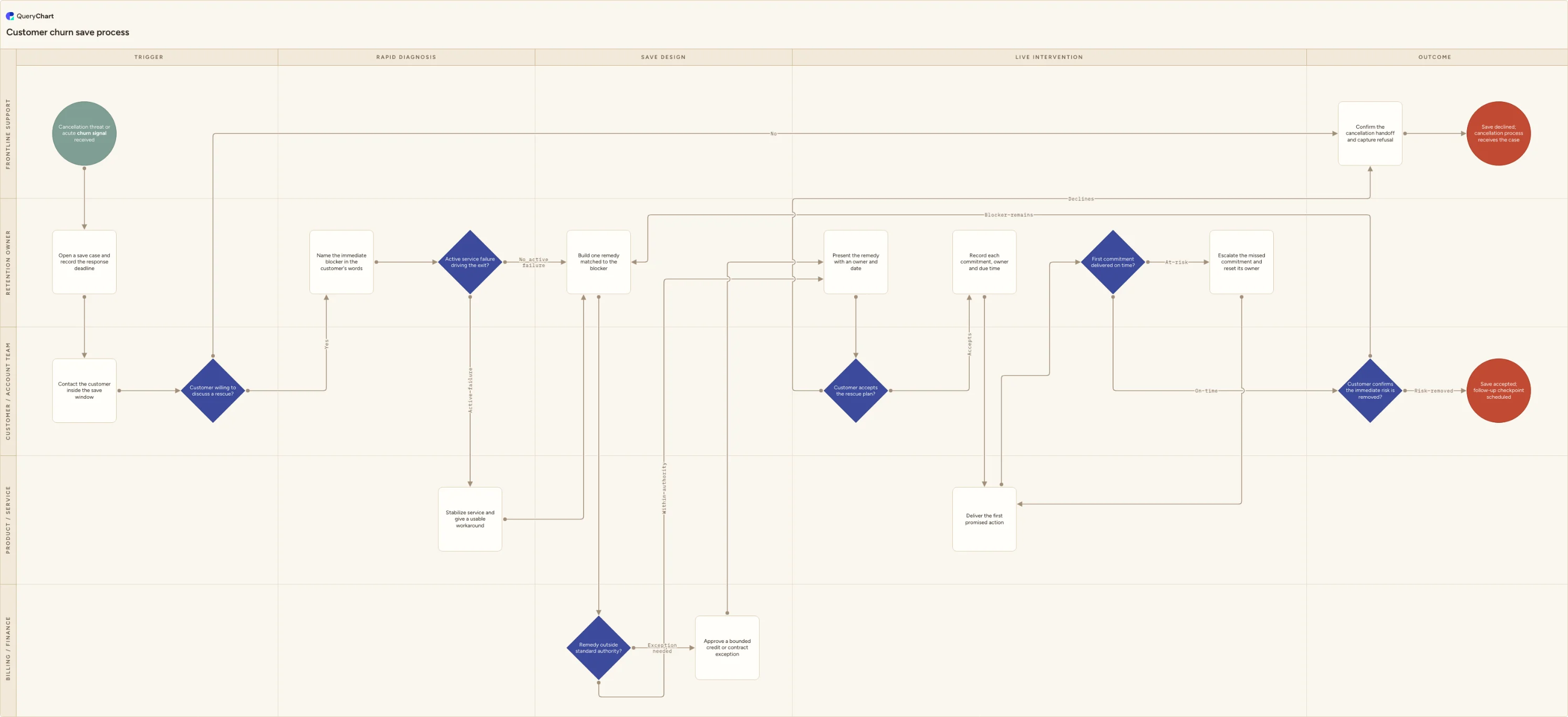
Customer churn save process flowchart (immediate intervention)
Customer churn save process template for an urgent cancellation threat: rapid diagnosis, service stabilization, bounded remedy approval, customer commitment and deadline-controlled follow-through.
What the customer churn save process flowchart (immediate intervention) process is
This flow starts at the moment a customer says they may leave, not weeks earlier in health scoring and not after a cancellation has been accepted. Frontline support records the deadline while the retention owner makes contact inside the save window, captures the blocker in the customer's own language and tests whether a live service failure must be stabilized before any commercial proposal is discussed. A single remedy is then matched to that blocker, checked against financial authority, presented with a named owner and date, and followed through until the customer confirms the immediate risk has actually been removed.
That narrow boundary separates this template from the broader customer churn process, which covers risk detection, offboarding, churn analysis and win-back, and from a customer cancellation process, which administers an exit once the decision is made. This chart is the emergency bridge between signal and outcome. It deliberately avoids an endless discount ladder: a customer unwilling to discuss a rescue, or one who declines the bounded plan, is handed cleanly to cancellation. A customer who accepts is not counted as saved at the word yes; the chart requires the first promised action to land on time and loops a missed commitment back through escalation, because breaking the rescue promise is often worse than making no offer at all.
What this flowchart covers
In this template
- Five swimlanes across Trigger, Rapid diagnosis, Save design, Live intervention and Outcome, with a single retention owner coordinating support, service, finance and the customer-facing account team
- A willingness gate before discovery so a clear refusal moves to cancellation instead of triggering unwanted calls and improvised offers
- A service-failure check that stabilizes the product and supplies a workable workaround before a commercial remedy is designed
- A bounded authority decision for credits or contract exceptions, followed by a rescue plan that names the owner and delivery date
- Two proof points after acceptance: the first commitment must arrive on time, and the customer must confirm that the immediate blocker is gone before the save is closed
When to use this template
- A customer has threatened cancellation during a support or account conversation and the team needs to coordinate a response within hours, not at the next health review
- Retention attempts depend on whoever answers the message, so remedies, authority limits and ownership vary from case to case
- Customers verbally accept save plans but churn anyway because the first operational promise is late or nobody checks whether the blocker was removed
- You already have lifecycle churn and cancellation procedures but need the missing intervention between confirmed danger and either retention or handoff
How it works
Set the save window
Define how quickly the retention owner must contact the customer after the trigger and which signals qualify for this urgent path. Use a clock your team can actually meet, and make the case timestamp visible so the handoff is not lost between support and the account team.
Write the blocker interview
Give the owner a short set of questions that separates a live service failure, price pressure, adoption friction and a missing capability. Capture the customer's words before selecting a remedy; otherwise the team will reach for its easiest concession rather than the intervention most likely to work.
Define bounded remedies
List the service actions, success support, credits and contract exceptions available at each authority level. Put a maximum value and expiry on every commercial concession, and identify the finance approver who can respond within the save window.
Make acceptance measurable
Replace a vague promise to improve with an owner, a due time and the first observable action. The save is provisional until that action is delivered and the customer confirms the immediate blocker is removed.
Test both endings
Walk one accepted rescue and one refusal through the chart. Confirm the accepted branch creates a follow-up checkpoint and the refused branch transfers the reason, conversation and commitments to cancellation without forcing the customer to repeat them.
Frequently asked questions
What are the steps in an immediate customer churn save process?
Open a time-stamped save case, contact the customer within the save window, confirm they are willing to talk, capture the immediate blocker, stabilize any active service failure, design one remedy matched to that blocker, obtain approval if it exceeds standard authority, present it with an owner and date, record acceptance or refusal, deliver the first commitment on time and ask the customer whether the immediate risk is removed. Acceptance closes into a scheduled follow-up; refusal moves directly to cancellation with the context preserved.
How is this different from a full customer churn process?
A full churn process begins with risk signals and may continue through retention, offboarding, reason analysis and win-back. This template covers only the high-pressure intervention after the risk has become acute. It does not maintain health scores, run an exit interview, revoke access or schedule a future campaign. Its purpose is to get the right people around one live blocker quickly and to prevent a verbal save from being declared successful before the first promise is delivered.
Should every cancellation threat receive a discount?
No. The remedy should match the blocker. A live outage needs stabilization and a workaround; an adoption problem may need focused enablement; a missing capability may need an honest alternative or dated product answer; price pressure may justify a bounded commercial change. A generic discount can lower revenue without removing the reason the customer wants to leave, and it can teach customers that threatening cancellation is the normal route to a better price.
When should the team stop trying to save the customer?
Stop when the customer declines a discussion, rejects the bounded rescue plan or asks to proceed without further offers. The flow then records the refusal and hands the case to cancellation. A save process should create one fast, relevant opportunity to repair the situation, not an obstacle course that delays a decision the customer has already made.
Where this process fits
In most operations this process hands off to Customer cancellation process flowchart (request to account closed).
Comes after
- Customer cancellation process flowchart (request to account closed) — Customer cancellation process flowchart: contract terms and notice period, reason coded before any save attempt, the offer ladder and its limits, final billing, data export, deprovisioning and churn coding.