Service recovery process flowchart (restoration to customer trust)
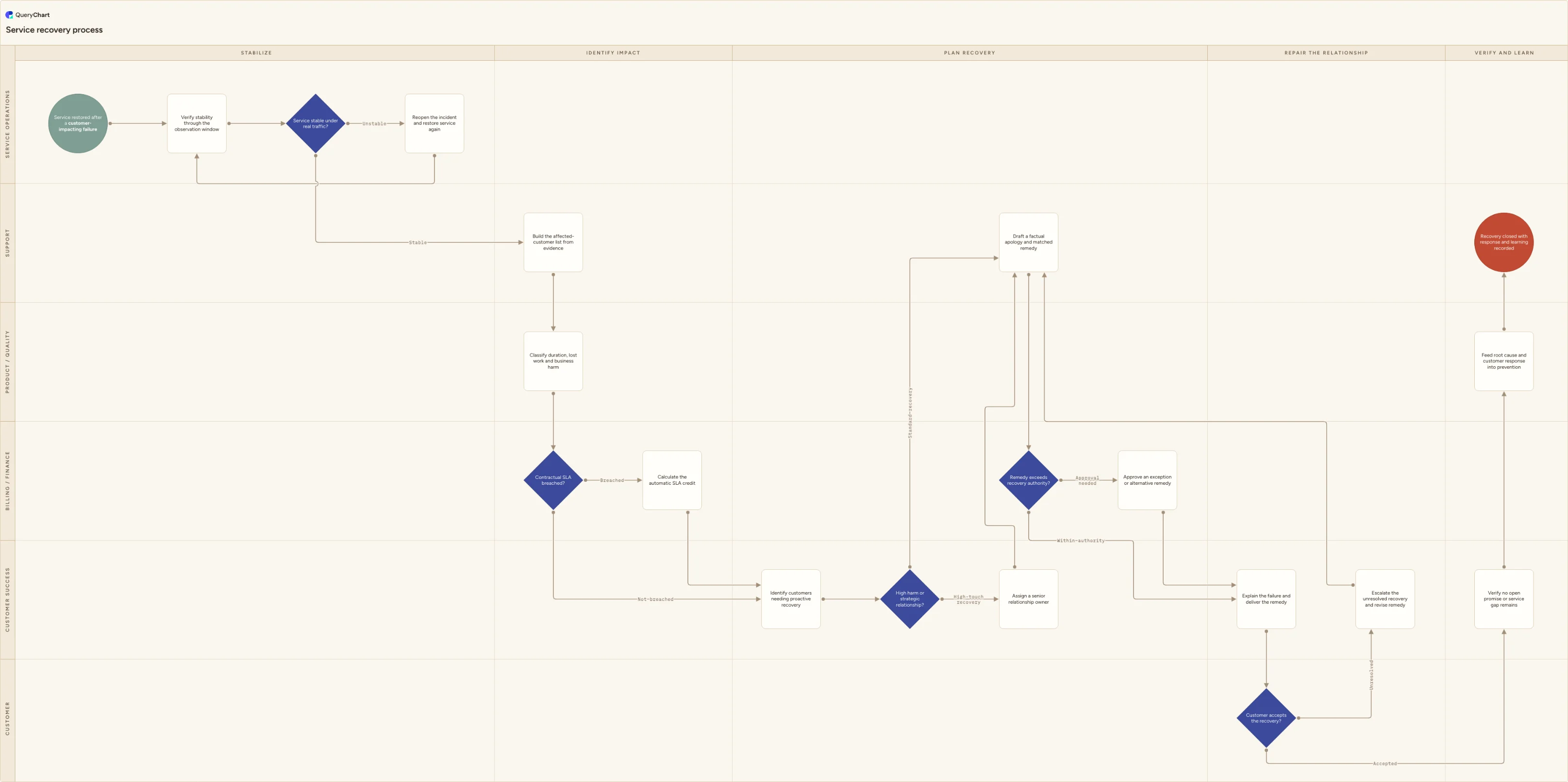
Service recovery process template for work after restoration: stability proof, affected-customer evidence, SLA credits, harm-based remedies, customer acceptance and prevention feedback.
What the service recovery process flowchart (restoration to customer trust) process is
Restoring a system ends the incident response, but it does not automatically recover the customer relationship. Customers may have lost work, missed a deadline or spent hours proving a fault, and a generic all-clear message does not address any of that. This chart starts after restoration, verifies that the service remains stable under real traffic, builds the affected-customer list from evidence, classifies actual harm and checks the contract for an automatic SLA credit. It then selects proactive recovery by harm rather than by who complains loudest, drafts a factual apology and remedy, and routes only out-of-authority remedies for approval.
The scope is deliberately post-failure. Incident management owns detection, technical command and restoration; complaint handling owns a continuing allegation that needs formal investigation; churn save owns an immediate threat to leave. Service recovery uses the outputs of those processes but asks a different question: what must be repaired now that service is back? The customer receives an explanation and matched remedy, accepts it or sends the unresolved case through a controlled revision loop, and the team verifies that no promise or service gap remains. Root cause and customer response then feed prevention and the support playbook, so a credit is not mistaken for corrective action and a technical fix is not mistaken for restored trust.
What this flowchart covers
In this template
- Six role lanes across Stabilize, Identify impact, Plan recovery, Repair the relationship, and Verify and learn, beginning only after technical restoration
- A stability gate under real traffic that reopens the incident when the service has not survived its observation window
- Evidence-based affected-customer and harm classification, plus a separate contractual SLA-credit decision before discretionary remedies are designed
- High-touch versus standard recovery based on harm and relationship exposure, with a bounded approval gate for exceptional remedies
- Customer acceptance, an unresolved-recovery revision loop, verification of every open promise and a final feed from root cause and response into prevention
When to use this template
- An outage or serious service failure has been restored, but support and customer success do not have a consistent way to identify and contact everyone harmed
- SLA credits are issued inconsistently or only to customers who complain, while discretionary gestures are confused with contractual remedies
- Teams close incidents when monitoring is green even though customer commitments, lost work or relationship damage remain unresolved
- Post-incident reviews improve infrastructure but do not feed customer response and communication failures back into the support playbook
How it works
Define the recovery handoff
State the evidence incident command must provide when service is restored: observation window, affected components, customer identifiers, start and end times, known data loss and the technical owner. Recovery should not begin from a vague all-clear message.
Classify harm from evidence
Create a short harm scale covering duration, lost work, blocked business events, safety or compliance exposure and strategic commitments. Use telemetry and ticket evidence rather than complaint volume, because quiet customers may have suffered the greatest impact.
Separate credits from remedies
Calculate contractual SLA credits automatically from the agreement. Then define discretionary remedies for time lost, repeated failures or relationship damage, with authority limits and an approver. A required credit is not an apology, and a goodwill gesture does not replace it.
Write the customer conversation
Require a factual explanation of what failed, the verified impact, what has changed, the remedy and every owner and date. Avoid promising a root cause before investigation is complete, but do not hide behind technical uncertainty when the customer impact is already known.
Close every open promise
Record whether the customer accepted recovery and list any follow-up commitment separately from incident actions. Feed both the root cause and customer response into prevention, then close only when the service gap and relationship promises have named owners or are complete.
Frequently asked questions
What are the steps in a service recovery process?
Verify that restored service remains stable, reopen the incident if it does not, identify affected customers from evidence, classify duration and business harm, determine whether an SLA credit is due, choose high-touch or standard recovery, assign a senior owner where needed, draft a factual apology and matched remedy, approve any exception, contact the customer, revise unresolved recovery, verify all promises and feed the root cause and customer response into prevention before closure.
How is service recovery different from incident management?
Incident management detects, contains, diagnoses and restores the service. Service recovery starts after restoration and repairs the consequences for customers: evidence of who was affected, contractual credits, communication, discretionary remedies, acceptance and follow-up. The two processes exchange information, but declaring the incident resolved does not mean customer recovery is complete.
Who should receive a service recovery remedy?
Use evidence and a written harm scale, not only inbound complaints. Everyone contractually owed an SLA credit should receive it according to the agreement. Proactive or high-touch recovery should then consider lost work, blocked business events, repeat failures, strategic commitments and relationship exposure. This prevents the loudest customer from receiving the largest gesture while a quieter customer with greater harm receives nothing.
When is service recovery complete?
Recovery is complete when stability has been proved, required credits and approved remedies have been delivered, the customer has accepted the resolution or an unresolved path has an explicit owner, and every promise has been completed or scheduled. Root cause and customer-response findings must also enter the prevention and support backlogs; otherwise the case is compensated but not learned from.
Where this process fits
In most operations this process follows Incident management process flowchart and hands off to CSAT survey follow-up process flowchart.
It is one step in Customer support.
Step 2: Customer support escalation process flowchart (tier 1 to tier 2)
Swimlane customer support escalation process flowchart: first-line attempt, documented tier 2 handover, severity and SLA check, engineering escalation.
Step 3: Service recovery process flowchart (restoration to customer trust) You are here
Service recovery process template for work after restoration: stability proof, affected-customer evidence, SLA credits, harm-based remedies, customer acceptance and prevention feedback.
Step 4: CSAT survey follow-up process flowchart
CSAT survey follow-up process flowchart for response linking, low-score recovery, contact consent, case reopening, remedy decisions, sentiment checks and recurring-theme action.