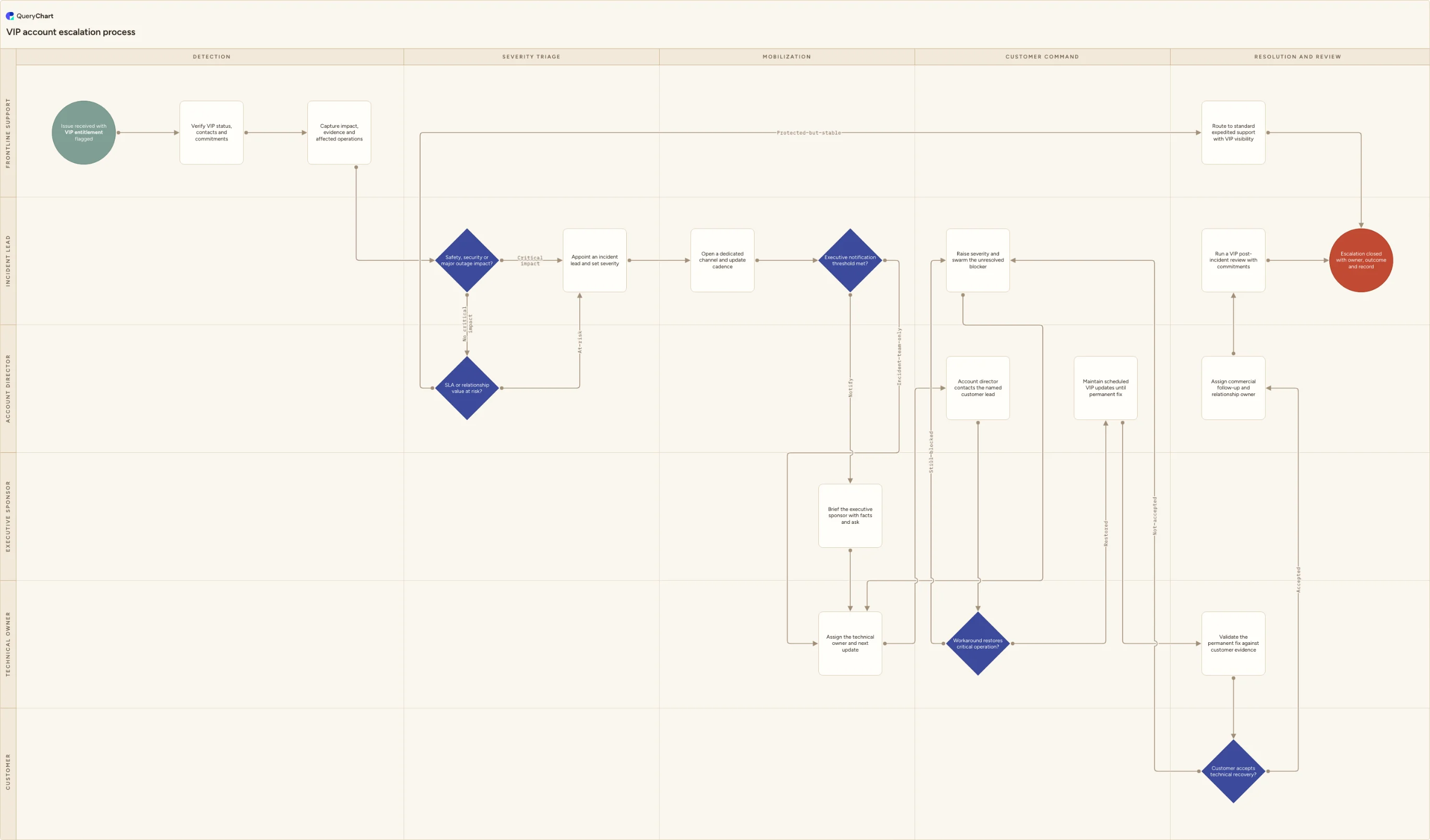
VIP account escalation process flowchart (severity and relationship)
VIP account escalation template combining incident severity with SLA and relationship risk, named technical and account owners, executive thresholds, customer updates and post-incident commitments.
What the VIP account escalation process flowchart (severity and relationship) process is
VIP handling fails when the label means only 'reply faster'. A protected account can bring two kinds of exposure at once: operational harm from the issue itself and relationship harm from a missed commitment, a strategic launch or a customer executive learning about the problem before their account director does. This flow verifies the account's entitlement and named contacts at intake, captures evidence, tests for safety, security or major-outage impact, then separately tests the SLA and relationship value at risk. Only a case that crosses one of those thresholds receives an incident lead, dedicated channel and controlled update cadence.
The template is not the generic customer-support escalation flowchart, which decides whether ordinary work belongs with frontline, second-line or engineering. It adds the relationship command that a VIP case needs after routing: an account director contacts the customer's named lead, an executive sponsor is briefed only when a written notification threshold is met, and technical recovery is not accepted on internal monitoring alone. The customer confirms the workaround and permanent fix against their evidence, then commercial follow-up and a VIP post-incident review capture commitments. A protected but stable case remains visible while moving through expedited standard support, avoiding the opposite failure in which the VIP tag summons executives for a routine question.
What this flowchart covers
In this template
- Six role lanes across Detection, Severity triage, Mobilization, Customer command and Resolution and review, pairing technical ownership with account and executive ownership
- Two independent entry tests: critical operational impact, and SLA or relationship value at risk, so commercial importance does not overwrite technical severity
- A written executive-notification threshold and a fact-based sponsor brief, rather than automatic executive paging for every VIP ticket
- A dedicated incident channel, update cadence, named technical owner and named customer lead, with severity raised when a workaround leaves the customer blocked
- Customer acceptance of technical recovery followed by commercial follow-up and a post-incident review that records commitments and owners
When to use this template
- Your support plan includes strategic, VIP or contractually protected accounts and the handling promise needs to be operational rather than a CRM badge
- Technical teams and account directors disagree about whether a case is severe because one is measuring system impact and the other is measuring relationship exposure
- Executives are either notified about every premium ticket or surprised by the few cases that genuinely threaten an important relationship
- A VIP customer receives frequent updates during an outage but no named owner for commercial repair or post-incident commitments afterward
How it works
Define VIP entitlement
State whether VIP status comes from contract, strategic-account designation, launch protection or another explicit rule. Store the named customer lead, account director, executive sponsor and current commitments where the intake agent can verify them without searching across systems.
Separate severity from relationship risk
Write observable triggers for safety, security and outage impact, then a separate set for SLA exposure, strategic events and revenue risk. Keep both tests because a low-severity defect can still threaten a launch, while a broad incident can affect a VIP without requiring bespoke executive intervention.
Set the notification threshold
Specify when the executive sponsor is informed, what the brief must contain and what decision or support is being requested. A notification with no ask creates noise; a threshold based only on ticket priority leaves contract and relationship exposure invisible.
Agree the update cadence
Define who writes technical updates, who delivers them to the customer and how often they continue when there is no material change. Use one dedicated channel and time-stamped next-update commitments so technical and account messages cannot contradict each other.
Close technical and commercial work separately
Require the customer to validate recovery before technical closure, then assign any credit, executive follow-up or trust-repair commitment to an owner and review date. The incident can be fixed while the relationship remains damaged; the process should show both states.
Frequently asked questions
What should trigger a VIP account escalation?
A VIP label alone should trigger verification and visibility, not necessarily full mobilization. Escalate when the case has safety, security or major-outage impact, or when an SLA, protected event, strategic relationship or material revenue commitment is at risk. Those tests should be answerable from evidence and account data. A protected but stable request can stay in expedited standard support with the account director able to see it.
Who owns a VIP escalation?
The incident lead owns severity, coordination and cadence; the technical owner owns diagnosis and recovery; the account director owns the customer relationship and commercial follow-up. An executive sponsor joins only at the agreed threshold. One person may fill two roles in a small company, but the responsibilities should remain explicit so neither technical recovery nor customer communication is assumed to belong to someone else.
When should an executive sponsor be notified?
Notify when a written threshold is met, such as safety or security exposure, a major outage, likely breach of a protected SLA, a strategic launch at risk or a customer executive already involved. The brief should contain verified impact, current severity, technical owner, next update, customer sentiment and a specific ask. Routine awareness can be handled in reporting instead of interrupting the sponsor during every premium case.
When is a VIP incident ready to close?
Not when monitoring first turns green. The permanent fix must be validated against the customer's evidence, the customer must accept that critical operation is restored, and commercial or relationship follow-up must have an owner. The final review records what was promised, what changed in the technical or communication playbook and who will report back to the customer.