Near miss reporting process flowchart (close calls and high potential)
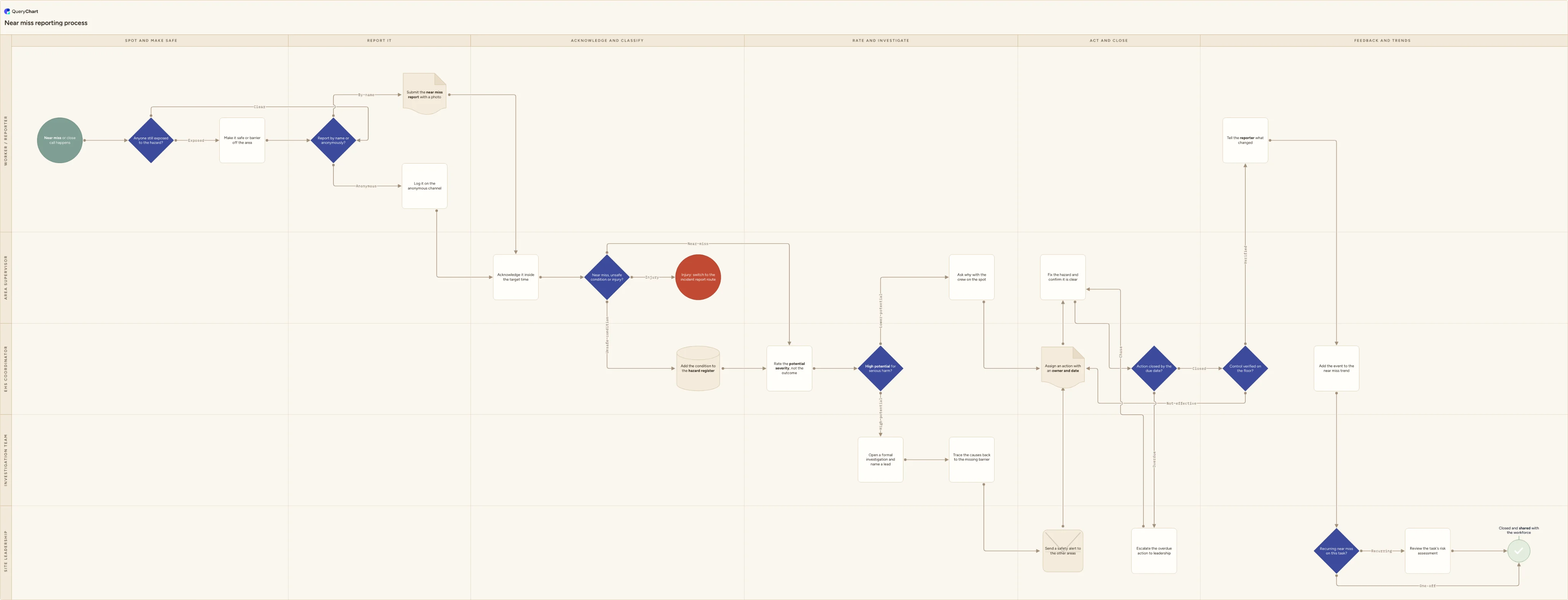
Near miss reporting process flowchart template: make the area safe, report by name or anonymously, supervisor acknowledgement, classification, potential severity rating, high potential investigation and feedback to the reporter.
What the near miss reporting process flowchart (close calls and high potential) process is
A near miss is an unplanned event that injured nobody and damaged nothing, but realistically could have. The trigger is a person noticing it: a load that swung over an empty walkway, a reversing truck that stopped a metre short, a valve found open that should have been locked off. Nothing has to be repaired and nobody has to be treated, which is exactly why the event disappears unless there is a route for it. This chart follows one close call from the moment it is seen to the moment it is closed: making the area safe, submitting the report by name or through the anonymous channel, the supervisor acknowledging it inside a target time, classifying what was actually described, rating the harm it could have caused, investigating the high-potential ones properly, assigning and verifying a corrective action, telling the reporter what changed, and feeding the event into the trend the safety committee reads.
This is the reporting route for events that hurt nobody. If someone was injured, made ill or needed treatment, the chart hands off at the 'Near miss, unsafe condition or injury?' decision and the workplace incident reporting process takes over, with its first aid, its absence recording and its statutory reporting window. The deep investigation of a serious event is a separate process again: this chart opens one and names a lead, but the evidence handling, the witness interviews and the systemic analysis belong to the safety incident investigation process. Nor is this a worker's right to halt a job, which is stop-work authority and is drawn on its own; here the work has usually carried on by the time anyone writes anything down. Treat the chart as a starting point to be adapted under your own procedures, your regulator's requirements and competent-person review, rather than as a compliance document in itself: whether an event must be reported to an authority, and how quickly, is settled by the law where you operate and not by this diagram.
Four decisions carry the chart. 'Report by name or anonymously?' sits in the worker's lane at the very start, because the design choice that most affects how many reports you get is made before anyone fills anything in. 'Near miss, unsafe condition or injury?' sits with the area supervisor, who reads the report first and is the only person placed to say whether the thing described is an event, a standing condition, or an injury that belongs somewhere else entirely. 'High potential for serious harm?' sits with the EHS coordinator rather than the supervisor on purpose: the person closest to the job is also the person most likely to have normalised it, and the rating is about the outcome that did not happen. And 'Control verified on the floor?' sits after the action has been marked closed, not before, because the register and the workplace disagree far more often than anybody expects.
What this flowchart covers
In this template
- Five swimlanes (Worker / reporter, Area supervisor, EHS coordinator, Investigation team and Site leadership) across six phases: spot and make safe, report it, acknowledge and classify, rate and investigate, act and close, and feedback and trends
- An immediate branch before any paperwork: "Anyone still exposed to the hazard?" routes the reporter through "Make it safe or barrier off the area", so the walkway is cleared or the load is landed before anybody opens a form
- "Report by name or anonymously?" drawn as a first-class branch, with a named report carrying a photo and an anonymous entry joining the same queue, so the channel that catches what people will not sign their name to is designed rather than assumed
- A three-way "Near miss, unsafe condition or injury?" classification in the supervisor's lane: an injury leaves the chart for the incident reporting route, an unsafe condition is added to the hazard register, and a near miss goes on to be rated
- "High potential for serious harm?" as the fork that decides how much process the event earns: a formal investigation with a named lead, causes traced back to the missing barrier and a safety alert to other areas, or "Ask why with the crew on the spot"
- Closure on evidence rather than on trust, with an overdue action escalated to leadership and chased, "Control verified on the floor?" sending an ineffective fix back to be re-planned, and only a verified control reaching "Tell the reporter what changed" and the trend
When to use this template
- You are writing or rewriting a near miss procedure and need one picture of who reports, who acknowledges, who rates the potential and who closes the action
- Reports have dried up, and you need to see whether the loss is at the form, at the acknowledgement, or at the feedback that nobody ever sends back
- You are configuring a reporting app or a QR-code form and want the classification, the potential rating and the escalation agreed before the fields are built
- Your near miss log is full of housekeeping items and nothing high potential, so the rating step and the threshold behind it need to be explicit and owned
- An auditor or certification body has asked how close calls are reported, investigated and acted on under your health and safety management system
How it works
Rename the lanes to your roles
Replace Worker / reporter, Area supervisor, EHS coordinator, Investigation team and Site leadership with the roles you genuinely have. On a small site the EHS coordinator and the supervisor are the same person, so merge those lanes rather than drawing a handoff that never happens, and add a contractor lane if contractors report into your system.
Write your own definition of a near miss
Say plainly what counts, because people will not report what they cannot name. Decide whether property damage with no injury, a dropped object, an unsafe act and a standing unsafe condition all arrive through this route, and put examples from your own site on the procedure instead of generic ones borrowed from a textbook.
Set the channels and decide on anonymity
Name every way a report can arrive: a paper card, an app, a QR code on the noticeboard, or a word to the supervisor written up afterwards. Then decide whether the anonymous channel exists, who reads it, and what detail the form must carry to be actionable when nobody can be asked a follow-up question.
Set the acknowledgement target and its owner
Put a real number on the acknowledgement step: same shift, twenty-four hours, two working days. The placeholder on the chart is a field to fill in, not a rule. Decide who acknowledges when the supervisor is the subject of the report, and how a reporter learns that the report was received at all.
Define high potential and who applies it
Write the test down before you need it. Most organisations ask what the worst realistic outcome would have been had one further barrier failed, and treat anything that could have killed or permanently disabled someone as high potential. Say who rates it, whether a second person moderates the rating, and what a high-potential rating obliges the site to do.
Agree the action, the verification and the reply
Decide who may own an action, what the longest acceptable due date is, who may extend one, and who is told when it slips. Agree what verification actually means: someone going to look at the workplace, and who signs it off. Finally settle the form the reply to the reporter takes and who sends it, because that step is the one that quietly disappears.
Walk it against last month's real reports
Take a handful of recent near misses, including one that was rated high potential and one that was closed the same day, and trace each of them through the chart. Any step people describe that is not drawn, or that is drawn but skipped in practice, is the finding worth acting on before you publish the procedure.
Frequently asked questions
What are the steps in a near miss reporting process?
A worker sees a close call. If anyone is still exposed, the area is made safe or barriered off first. The event is then reported, by name with a photo or through the anonymous channel, and the supervisor acknowledges it inside the target time. The report is classified: an injury leaves for the incident reporting route, an unsafe condition is added to the hazard register, and a near miss carries on. The EHS coordinator rates the potential severity rather than the outcome. High-potential events get a formal investigation with a named lead, causes traced back to the barrier that was missing, and a safety alert to the other areas; lower-potential ones get a short why-question with the crew on the spot. An action is assigned with an owner and a date, carried out, chased if it slips, and verified on the floor. Finally the reporter is told what changed and the event joins the trend.
What is the difference between a near miss and an incident?
It depends whose vocabulary you are using, which is why your procedure must define it. ISO 45001:2018 defines an incident as an occurrence arising out of, or in the course of, work that could or does result in injury and ill health, and notes that an occurrence where no injury or ill health results may be called a near miss, a near hit or a close call. On that reading a near miss is a kind of incident, not its opposite. The National Safety Council describes it as an unplanned event that did not result in injury, illness or damage but had the potential to do so. Many organisations use incident loosely for anything that did cause harm and near miss for anything that did not, and add a third word, unsafe condition, for a hazard nobody has yet come close to. Pick your words, write the examples down, and use them consistently on the form, in the register and at the safety committee.
Do near misses have to be reported to a regulator?
Usually not, though the answer is jurisdictional rather than universal. Under the United States recordkeeping rules in 29 CFR Part 1904, an event becomes recordable only when there is a work-related injury or illness, so a genuine near miss does not go on the OSHA 300 log, although OSHA encourages employers to investigate close calls internally. In Great Britain, RIDDOR 2013 takes a different route: specified near-miss events called dangerous occurrences, listed in Schedule 2, are reportable to the Health and Safety Executive whether or not anyone was hurt. Examples include the collapse or overturning of lifting equipment and an electrical short circuit causing fire or explosion. So most near misses stay inside your own system while some named categories do not, and the list, the timescales and the route are set by the regulator where you operate. Check yours rather than assuming.
How do you decide whether a near miss is high potential?
There is no standardised definition, so organisations write their own test. The usual question is what the worst realistic outcome would have been had one further barrier failed, and the common threshold is a fatality or a life-changing injury. Rating on the actual outcome is the mistake that hides the events worth learning from: an object that fell onto an empty walkway is the same failure as one that fell onto a person; only the timing differed. Two habits help. Have someone outside the area rate it, because familiarity normalises risk, and moderate the ratings in a group at first so the threshold means the same thing across the site. Note that the classic accident triangle, and the fixed ratio of minor to serious events quoted with it, has never been reproduced from its original data and is contested in the literature, so do not run the programme on a ratio; rate the events you have.
Why do near miss reports dry up, and what keeps them coming?
Three things kill a reporting system: nothing visibly changes, the form takes too long, and somebody got blamed. The first is the most common and the easiest to fix, which is why the acknowledgement step and the reply to the reporter are drawn here rather than assumed. ISO 45001 requires organisations to identify and remove obstacles to worker participation and names reprisals and threats of reprisals among them, so a system that punishes the reporter is a nonconformity as well as a bad idea. The same principle appears in the United States recordkeeping rule for injuries and illnesses, which says a reporting procedure is not reasonable if it would deter a reasonable employee from reporting; that is a fair test for your near miss channel too. Be careful with report-count targets: counting reports as a performance measure produces reports, not necessarily the ones you needed.
Where this process fits
In most operations this process hands off to Workplace incident reporting process flowchart (health and safety).
It is one step in Safety incidents.
Step 1: Near miss reporting process flowchart (close calls and high potential) You are here
Near miss reporting process flowchart template: make the area safe, report by name or anonymously, supervisor acknowledgement, classification, potential severity rating, high potential investigation and feedback to the reporter.
Step 2: Workplace incident reporting process flowchart (health and safety)
Workplace incident reporting process flowchart for accidents and near misses: first aid, reporting window, statutory report, investigation, corrective actions.
Step 3: Safety incident investigation process flowchart (scene to controls)