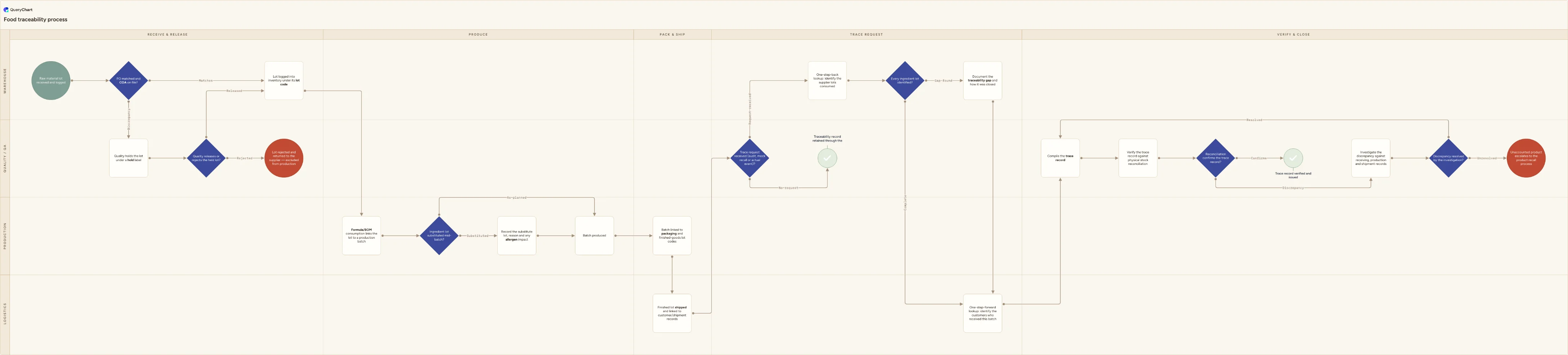
Food traceability process flowchart (lot receipt to trace record)
Food traceability process flowchart template: raw material lot receipt, formula/BOM linkage to a batch, packaging and shipment lot codes, one-up-one-back trace lookup, and physical stock reconciliation.
What the food traceability process flowchart (lot receipt to trace record) process is
Food traceability is the discipline of linking every lot that enters a facility to every lot that leaves it, tightly enough that a single trace request can answer two questions in minutes rather than days: which supplier lots went into this batch, and which customers received it. The trigger for the chart below is the moment a raw material lot crosses the dock, and it follows that one lot end to end: received and logged under its own identity, checked against the purchase order and its certificate of analysis, released or held by Quality, consumed against the formula or bill of materials that links it to a specific production batch, carried through to the finished-goods lot codes that batch is packaged under, and shipped under a record that names the customer and the quantity. From there the chart turns around. On a trace request, whether that is a scheduled mock recall, an auditor's sample or an actual quality event, the same records are read backward to the raw material lots and forward to the customers, compiled into one trace record, and checked against what is physically on the shelf before anyone calls it complete.
This chart is the identity and linkage layer, not the decisions built on top of it. Whether a batch is fit to release is the batch production process at /templates/batch-production-process, which this chart assumes has already happened by the time a lot reaches packaging. Whether a supplier is fit to ship you a lot at all is the food supplier approval process at /templates/food-supplier-approval-process, running long before the first row here. And when a hazard is confirmed and the answer is that product needs to come back, that decision belongs to the food product recall process at /templates/food-product-recall-process, not to this one: that chart's own trace step is deliberately a single box, because it assumes the lot linkage this chart builds already works, and this chart is the foundation it depends on. A raw material rejected here or a finding raised elsewhere on the floor hands off the same way, into the nonconforming product process. Keeping that boundary visible is what stops a traceability exercise turning into a redraw of every process it touches.
Three decisions carry most of the weight. "PO matched and COA on file?" is the gate that keeps traceability honest at the one point most of it is built on record-matching rather than physical inspection: an uncoded pallet let through here is untraceable for the rest of its life in the plant, however carefully every later step is done. "Ingredient lot substituted mid-batch?" exists because the commonest way a batch record quietly goes wrong is a floor-level swap that never reaches the paperwork, and if the substitute lot carries a different allergen than the one it replaced the gap is not just a traceability problem. And "Every ingredient lot identified?" inside the trace request itself is deliberately not a hard stop: a documented gap is still a truthful trace record, while a lookup that silently drops a lot it could not find is the failure a real recall discovers at the worst possible time.
What this flowchart covers
In this template
- Four swimlanes (Warehouse, Production, Quality / QA and Logistics) across five phases: receive and release, produce, pack and ship, trace request, and verify and close, so every lot has one named owner at each step forward and at the lookup backward
- A "PO matched and COA on file?" decision at receiving, so a raw material lot only enters the plant's identity chain once it is checked against its purchase order and certificate of analysis, with Quality holding and dispositioning anything that fails the check before it can be logged
- Formula/BOM consumption linking the lot to a production batch, and an "Ingredient lot substituted mid-batch?" decision that routes a floor-level swap into the batch record together with any allergen impact, rather than letting it go unrecorded
- A "Trace request received (audit, mock recall or actual event)?" gate that separates routine record retention from an actual trace: a one-step-back lookup for the supplier lots consumed and a one-step-forward lookup for the customers who received the batch, each owned by a different lane so neither side of the trace depends on one person's memory
- An "Every ingredient lot identified?" branch that documents a traceability gap rather than silently dropping it, and a "Reconciliation confirms the trace record?" decision that checks the compiled record against physical stock before it is called complete, sending any unresolved discrepancy toward the product recall process
When to use this template
- You are writing a lot traceability or one-up, one-back procedure and need one picture of how a raw material lot's identity travels through production, packaging and shipment, and how it is looked up again from either end
- A mock recall or trace exercise has taken longer than it should, or turned up a gap, and you need the backward and forward lookups drawn as real steps with a named owner rather than left to whoever remembers where the spreadsheet is
- You are deciding what your ERP, MES or spreadsheet-based system needs to capture at receiving, at BOM consumption and at shipment before you can answer a trace request from records instead of from memory
- A customer, auditor or certification body has asked how you would trace an affected lot forward and backward, and you need the process documented before you can answer with more than a description
- You are scoping what the food product recall process at /templates/food-product-recall-process would actually run on, and want the trace-and-lookup step it treats as a single box defined and tested first
How it works
Rename the lanes to your roles
Replace Warehouse, Production, Quality / QA and Logistics with the functions you actually have. On a small site the same person may receive the material, run the batch and ship the pallet; merge lanes rather than drawing a handoff between people who are the same person.
Set your own lot-coding scheme
Decide how a raw material lot code, an internal production batch number and a finished-goods lot code relate to each other, and write the rule onto the chart. Some sites reuse one number across all three, others generate a new one at each step and rely on a linking table; either is workable if the rule is written down and applied every time, not just when someone remembers.
Write the receiving check and the hold/release authority
State what "PO matched and COA on file?" actually checks, and who may place, release or reject a hold. A hold that exists only in a spreadsheet and not on the pallet itself is the gap an auditor finds fastest.
Define what counts as a reportable substitution
Set the rule for when an ingredient lot swap mid-batch has to be written onto the batch record, not just handled verbally on the floor. If the substitute could carry a different allergen than the ingredient it replaced, tie that check to your label and allergen control procedure, not just to this chart.
Decide your one-up, one-back lookup sources
Name the actual system or record each lookup reads from: the receiving log for the backward step, the shipment or order record for the forward step. If either lives on paper or in a spreadsheet nobody else can open, that is the traceability gap this chart will surface long before a real trace request does.
Set your reconciliation tolerance and the escalation trigger
Decide what counts as a reconciliation match rather than a discrepancy, who investigates a gap, and at what point an unresolved discrepancy escalates into the product recall process rather than staying an open trace investigation. Write the retention period for the compiled trace record from your own regulatory and customer requirements, not from a default.
Run a mock recall against it and time it
Pick a finished lot at random, and time how long it takes to produce a complete trace record entirely from what this chart says you can find. Any step people describe that the chart does not show, or a lookup that takes an afternoon of phone calls instead of a records search, is the finding worth fixing before an auditor or a real event does it for you.
Frequently asked questions
What are the steps in a food traceability process?
A raw material lot is received and logged under its own identity, checked against the purchase order and its certificate of analysis, and held or released by Quality before anything else happens to it. Once released, it is consumed against the formula or bill of materials that links it to a specific production batch; any mid-batch substitution is recorded against the batch record, along with any allergen impact. The batch is produced, linked to the finished-goods lot codes it is packaged under, and shipped under a record naming the customer, order and quantity. On a trace request, whether scheduled, from an auditor, or from an actual event, the same records are read backward to identify the supplier lots consumed and forward to identify the customers who received the batch. The two lookups are compiled into one trace record, verified against physical stock reconciliation, and either issued or, where a discrepancy cannot be resolved, escalated toward the product recall process.
What is one-up, one-back traceability, and is that all this template covers?
One-up, one-back is the traceability principle that a facility can name the immediate source of everything it receives, one step back, and the immediate recipient of everything it ships, one step forward, without necessarily tracing a product all the way to the farm or all the way to a consumer's kitchen. It is the backbone of most food traceability systems, because a chain of one-up, one-back links, followed through every facility a product passes, is what makes a full trace possible without any single site holding the whole picture. This template covers exactly that backbone: the internal linkage from a received lot through production and packaging to a shipped lot, and the two lookups that answer it. What sits on either side of it, tracing further back into your supplier's own suppliers or further forward past your direct customer, depends on your trading partners' own systems and any data-sharing agreement you have with them.
Does this template satisfy FSMA 204 or Codex food traceability requirements?
Not on its own, and whether either applies to you depends on your product and market. In the US, FSMA's Section 204 traceability rule requires certain Key Data Elements to be captured at Critical Tracking Events for foods on the FDA's Food Traceability List, and the compliance date has moved before, so check FDA's current guidance rather than assuming a date. Codex Alimentarius's General Principles of Food Hygiene, CXC 1-1969, frames traceability and product tracing as a tool for tracking a product through the stages of production, processing and distribution, without prescribing one universal recordkeeping format every country adopts identically. Many GFSI-recognised certification schemes, such as BRCGS, SQF or FSSC 22000, additionally require a periodic trace or mock recall exercise, at a frequency and pass standard set by the scheme and your certification body, not by this chart. Treat this template as an adaptable starting point for whichever of those actually apply to you, verified under your own regulatory and certification-scheme review, not as a compliance deliverable in itself.
How is food traceability different from a product recall?
Traceability is the recordkeeping that makes a recall possible; a recall is the market action that traceability data feeds. This chart never removes product from anyone's shelf: it links a lot's identity forward and backward and answers a trace request with a record. The food product recall process at /templates/food-product-recall-process is what actually happens once that record, or a confirmed hazard, means product needs to come back: assessing against the HACCP plan, activating the recall team, containing and notifying, recovering product, and closing through root cause and CAPA. That chart's own trace step is a single box for exactly this reason, and in practice the two are read together during a real event: the recall coordinator's first request is usually exactly the trace record this chart produces, and a facility that cannot produce it quickly is finding that out during the worst possible exercise to learn it in.
What does a mock recall or trace exercise actually test?
It tests whether the answer to which supplier lots and which customers can be produced from records in a defined time, not whether a real recall was ever needed. A good exercise picks a finished lot, sometimes announced and sometimes not, and times how long it takes to name every ingredient lot consumed and every customer who received it, using nothing but the records this chart's steps are supposed to produce. What it typically finds is not a missing regulation, it is a specific gap: a receiving record with no supplier lot code, a substitution that was handled verbally and never written onto the batch record, or a shipment logged by customer name but not by finished-goods lot code. Fixing those is cheaper before an auditor, a customer or an actual event finds them first.
Where this process fits
In most operations this process follows Food customer complaint process flowchart (intake to trend and CAPA review) and hands off to Food product recall process flowchart (safety-driven recall, not withdrawal).
It is one step in Food supply and traceability.
Step 1: Food supplier approval process flowchart (documentation to approved list)
Step 2: Incoming raw material inspection flowchart (receiving to release or hold)
Incoming raw material inspection flowchart: PO/spec check, supplier approval status, COA/allergen review, sampling and lab testing, then release, hold or concession.
Step 3: Food traceability process flowchart (lot receipt to trace record) You are here
Food traceability process flowchart template: raw material lot receipt, formula/BOM linkage to a batch, packaging and shipment lot codes, one-up-one-back trace lookup, and physical stock reconciliation.
Step 4: Food product recall process flowchart (safety-driven recall, not withdrawal)
Food product recall process flowchart: trace affected lots through batch records, assess against the HACCP plan, activate the recall team, contain and notify, recover product, and close through root cause and CAPA.