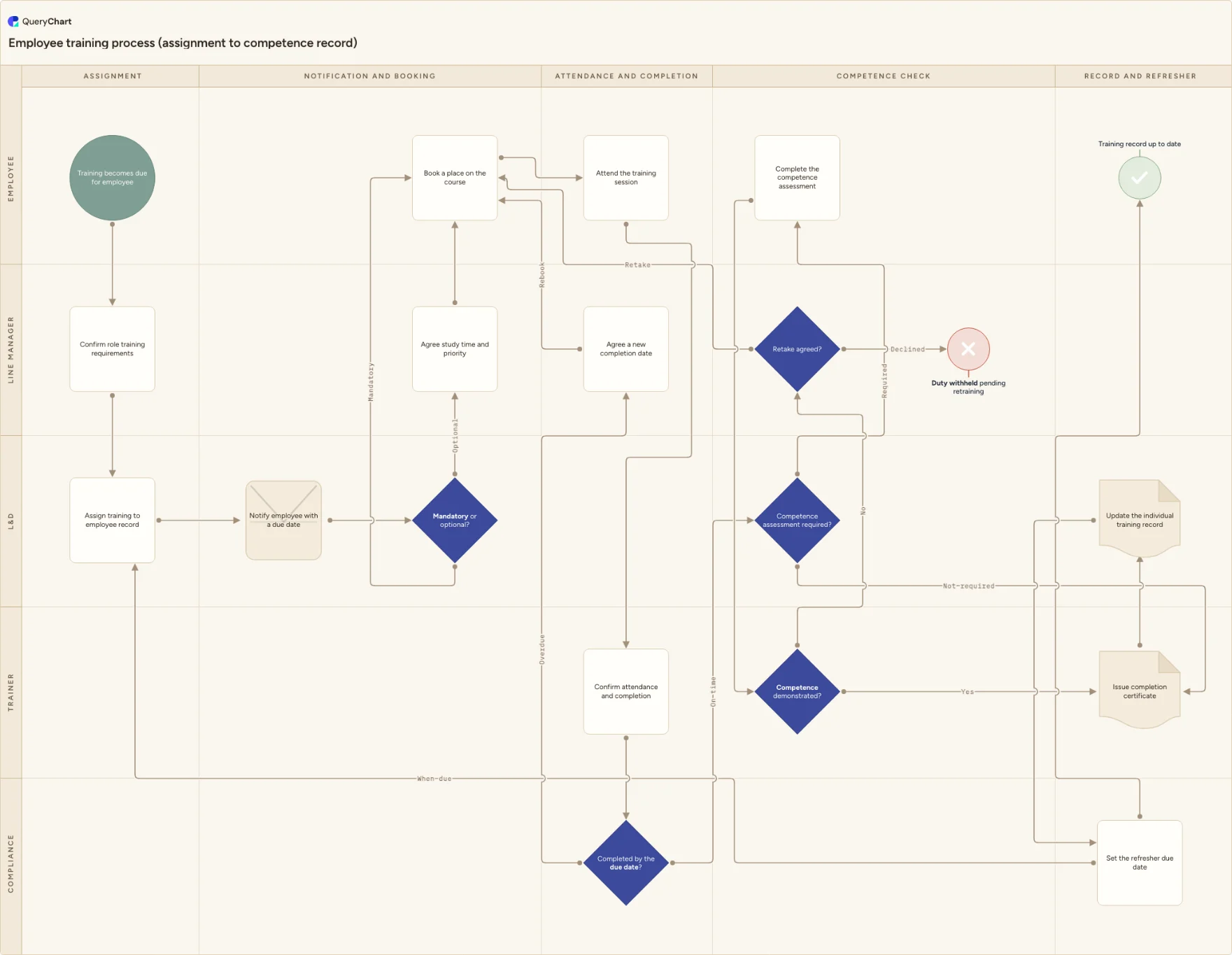
Employee training process flowchart (individual record)
Employee training process flowchart for one person's record: assignment and due date, mandatory or optional, attendance, competence check and refresher.
What the employee training process flowchart (individual record) process is
An employee training process is what happens to one training requirement once it lands on one person's record. It is assigned, it carries a due date, the employee books and attends, competence is judged where the work warrants it, and the record is updated so that someone can later show what that individual was trained on, when, and how the result was decided. Everything below is scoped to a single employee. There is no cohort, no budget round and no course catalogue in it.
That boundary is deliberate, because this is not the process that builds an organisation's training programme. Training needs analysis, the annual plan, budget and release approval, the decision to buy or build a course, and the later evaluation of whether the training changed anything in the workplace all sit upstream and operate on groups rather than individuals; that is the territory of the broader training process. This chart picks up after it: a course exists, and a named person has to complete it by a date. It also stops short of onboarding, which delivers a starter's first block of training inside a wider joining sequence, and short of the appraisal itself, which is only one of the three things that can put a requirement on the record in the first place.
Five lanes carry the flow. The Employee lane holds the points where the person actually acts, booking, attending and sitting the assessment, and it also holds the end state, because the record belongs to them. The line manager confirms what the role requires, releases time for optional training, absorbs the overdue escalation and decides whether a failed assessment gets another attempt. L&D assigns and records. The trainer delivers, judges competence and issues the certificate. Compliance owns dates, both the due-date sweep and the refresher. Separating dates from L&D is what makes overdue training visible to somebody whose job is to look at it.
What this flowchart covers
In this template
- Five swimlanes (Employee, Line manager, L&D, Trainer, Compliance) across five phases: Assignment, Notification and booking, Attendance and completion, Competence check, and Record and refresher.
- Assignment: "Training becomes due for employee" records which of the three triggers applied (a role requirement, a regulatory change or an action agreed at appraisal), the line manager confirms what the role needs, and L&D assigns it to the employee record and notifies them with a due date.
- A "Mandatory or optional?" split: mandatory assignments go straight to "Book a place on the course", while optional ones route through the line manager to "Agree study time and priority" before a place is booked.
- A "Completed by the due date?" sweep in the Compliance lane, whose overdue branch escalates across to the line manager to "Agree a new completion date" and returns the employee to booking rather than quietly closing.
- A "Competence assessment required?" decision that skips assessment for awareness-level training, then "Competence demonstrated?" in the Trainer lane. A failure passes to the line manager's "Retake agreed?" decision, which either sends the employee back to booking or ends at "Duty withheld pending retraining".
- Record and refresher: the trainer issues the completion certificate, L&D updates the individual training record, Compliance sets the refresher due date, and the refresher branch feeds back into assignment when it falls due.
When to use this template
- You can show that a course ran, but not that a named employee completed it by the date it was due.
- Mandatory or regulated training goes overdue and nobody has agreed who is told, how quickly, and what they are expected to do about it.
- You are configuring assignments, reminders and escalation rules in an LMS or HR system, and want the routing agreed before anyone builds it.
- An auditor, customer or regulator asks how competence is evidenced for one specific role holder, and the answer has to be a record rather than a course catalogue.
- Retakes and restricted duties are handled case by case, and the decision needs a named owner and a written outcome.
How it works
Rename the lanes to your real roles
Replace Employee, Line manager, L&D, Trainer and Compliance with the functions that genuinely do this work. In smaller organisations L&D sits inside HR and Compliance sits with quality or health and safety; merge those lanes rather than pretending they are separate people. If an external provider delivers the course, keep the Trainer lane and name the provider. Keep the Employee lane even though it holds only five nodes, because it shows every point at which nothing moves until the individual acts.
Write down what puts training on a record
The start node covers three triggers: the training requirements attached to the role, a change in regulation or standard, and an action agreed at appraisal. Cut the ones that do not apply and add any that do, such as a corrective action from an incident or a customer contract requirement. Record the trigger on the assignment, because it is normally what sets the due date and what justifies the deadline when someone asks for an extension.
Separate mandatory from optional and say where that is stored
Mandatory means the employee cannot decline it and the due date is set by the role, a regulation or a contract. Optional means the line manager decides whether it happens this quarter. Decide which field in your system carries that flag, and make sure the two lists are not merged in the employee's view, because a single undifferentiated list of assignments trains people to treat all of it as advisory.
Set the due date and the escalation clock together
A due date with no consequence is a suggestion. At the "Completed by the due date?" decision, define how long after the date the sweep runs, who receives the escalation, what they are expected to do, and what happens if the new date is also missed. Route it to someone with authority over the employee's time, which is usually the line manager rather than L&D.
State the pass criterion before the assessment exists
For each type of training, decide what demonstrating competence actually means: a test score, an observed task signed off by a named assessor, or a supervised period. Write it into the "Competence demonstrated?" decision. Without a stated criterion the result is a judgement made after the fact, and the record evidences attendance rather than competence.
Define the record fields, the retention period and the refresher interval
Specify what "Update the individual training record" must hold: the employee, the content and its version, the date, who delivered it, how competence was judged, the result and the next due date. Training records are personal data, so set a retention period and a review point rather than keeping them indefinitely by default. Then set the refresher interval per training type and note whether it comes from a regulation, an awarding organisation or your own policy.
Frequently asked questions
What is the difference between the employee training process and the training process?
They operate at different levels. The training process is organisation-wide: it identifies competence gaps across roles, runs a training needs analysis, builds an annual plan, approves budget and release of time, selects or designs courses, and evaluates whether the training worked. The employee training process is what happens to one requirement on one person's record once that programme exists: assignment, due date, mandatory or optional, booking, attendance, competence assessment, certificate, record update and refresher. If your problem is deciding what training the organisation should run, use the programme-level process. If your problem is proving that a named individual completed what they were required to complete, use this one.
What should happen when mandatory training goes overdue?
Give the overdue case its own route rather than leaving it to whoever notices. In this chart a "Completed by the due date?" sweep sits in the Compliance lane and its overdue branch crosses to the line manager, who agrees a new completion date and sends the employee back to booking. Three things make that work in practice: the sweep runs automatically over open assignments rather than depending on someone reading a report, the escalation reaches a person with authority over the employee's time, and the new date is recorded so a second miss is visible as a pattern rather than as a fresh incident. Where the training is a condition of performing a task, the honest option is to withhold the task until it is done, which is what the "Duty withheld pending retraining" node exists for.
What should an individual training record contain?
Enough to answer, years later, what this person was trained on and how competence was judged. That means the employee, the content and the version of it they received, the date, who delivered it, the method used to assess competence, the result, and the next due date. ISO 9001:2015 clause 7.2 asks an organisation to determine the competence needed, ensure people are competent on the basis of education, training or experience, act where there is a gap, and retain documented information as evidence of competence; ISO 45001 carries an equivalent clause for occupational health and safety. A sign-in sheet does not meet that, because it evidences attendance. Drawing the process does not satisfy any standard on its own either; the retained records and the assessment results are the evidence.
Does every course need a competence assessment?
No, and pretending otherwise devalues the ones that matter. Awareness-level training, such as a policy briefing or an annual refresher on a code of conduct, is reasonably evidenced by completion alone. Assessment belongs where getting it wrong has a consequence: operating equipment, handling regulated data, clinical or safety-critical tasks, or anything a customer or regulator will ask about by name. The "Competence assessment required?" decision in this chart exists so that the answer is set per training type in advance, rather than being improvised by whoever runs the session.
How often should refresher training be repeated?
The interval comes from one of three places, and it is worth recording which. Some qualifications carry a validity period fixed by the awarding organisation or a regulator, and the renewal date is not negotiable. Some are set by general legal duties: the Management of Health and Safety at Work Regulations 1999 require training to be repeated periodically where appropriate, without prescribing an interval, which leaves the organisation to justify what it chose. The rest are internal policy, usually driven by how quickly the content or the equipment changes. Set the interval per training type rather than applying one figure across the board, and give the reminder an owner, which in this chart is the Compliance lane, so that the refresher re-enters the assignment phase instead of relying on someone's memory.