How to plan construction handover, snagging and the defects period
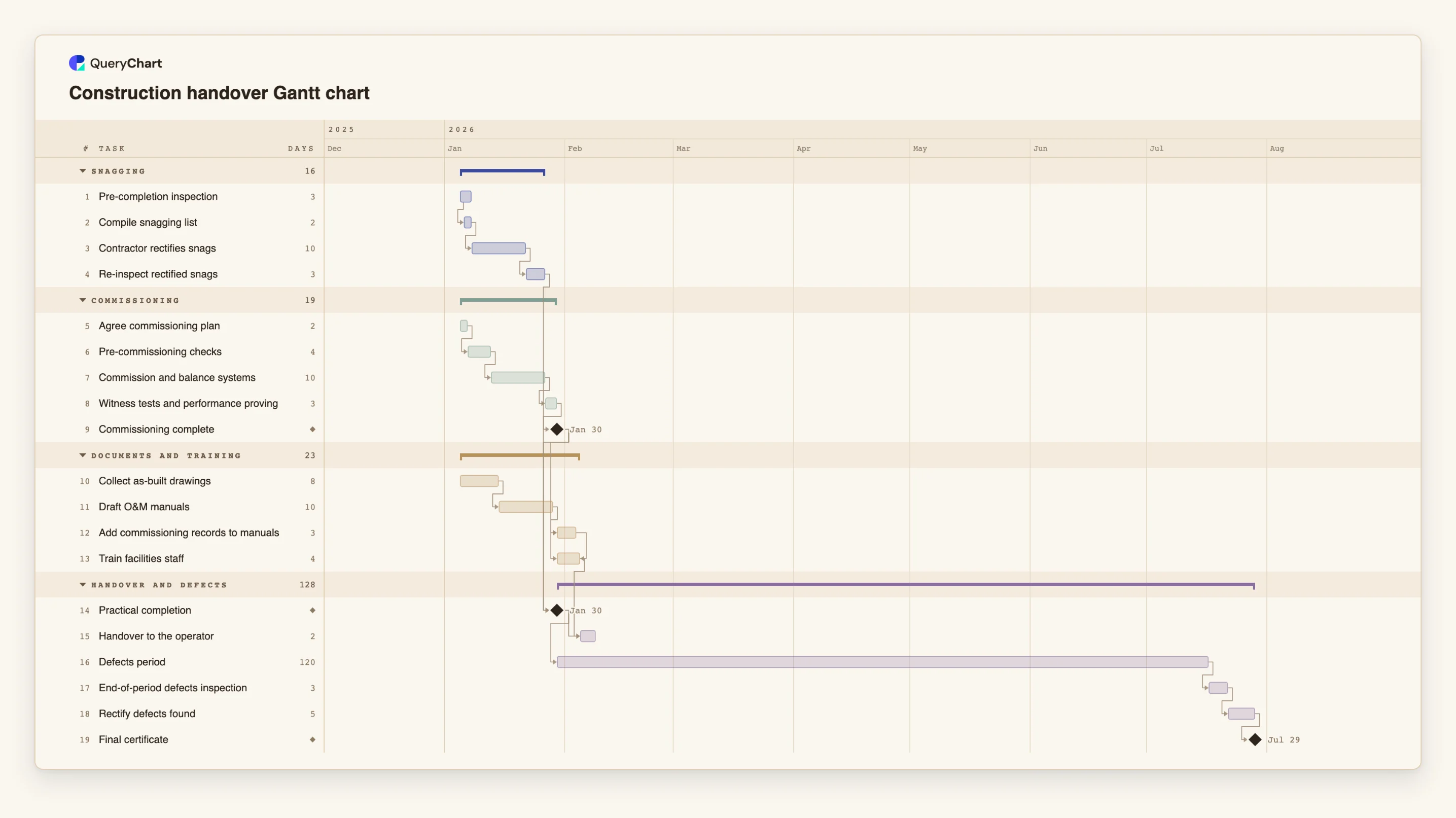
Plan the end of a construction project on a Gantt chart: snagging rounds, commissioning, O&M manuals and training, practical completion, handover and a defects period kept as a fixed wait.
The last weeks of a building project carry the most hidden dependencies. This guide shows how to lay out snagging, commissioning, documents and the defects period so that you can see what holds up practical completion and the final certificate.
The short version
- Split the end of the project into snagging, commissioning and documents, and let each be late on its own.
- Plan the inspection and the snagging list as overlapping tasks, and plan rectification in rounds.
- Tie the records and the training to commissioning, not to the date of the drawings.
- Treat the defects period as a task with a length that starts at practical completion.
- A schedule shows what is expected; the contract and the people with authority decide what is complete.
Why the end of a project slips
A construction schedule is usually built from the front: design, permits, structure, services, finishes. By the time you reach the end, the plan is a single line that says "handover". The work behind it is three streams that run at the same time and meet at different points: snagging, commissioning and the documents and training for the people who will run the building. Each can be late without the others being late, and a plan with one line cannot say which.
The method here is to split the end of the project by what each stream waits for. Snagging waits for an inspection. Commissioning waits for an agreed plan and for the systems being ready. Manuals can be drafted from the drawings early, but their records, and the training that uses them, wait for commissioning. Practical completion, as your contract defines it, waits for the streams that it names. The defects period then starts and has to run its course before the final certificate.
Be careful with the word complete. A chart shows when tasks are expected to finish. It does not certify that anything is finished, safe or accepted; that is decided under the contract, by the people with the authority to do so. Durations in the example are illustrative and the length of a defects period is whatever your contract says.
The example builds the construction handover template in stages. For the build itself use the construction guide at /guides/construction-schedule-gantt-chart and its template at /templates/construction-gantt-chart.
A construction handover, built in stages
Nineteen tasks in four phases. Durations are illustrative; use the lengths in your own programme and contract. Open the spreadsheet panel to see the rows behind each stage.
Snagging: inspect, list, rectify, re-inspect
"Pre-completion inspection" takes 3 working days. "Compile snagging list" (2) starts one working day after it starts, so the list is written as the inspection goes. "Contractor rectifies snags" is 10 days and "Re-inspect rectified snags" is 3.
Commissioning as its own chain
"Agree commissioning plan" (2), "Pre-commissioning checks" (4), "Commission and balance systems" (10) and "Witness tests and performance proving" (3) run one after the other, beside the snagging, and end at the "Commissioning complete" milestone.
Documents and training tied to commissioning
"Collect as-built drawings" (8) and "Draft O&M manuals" (10) start early. "Add commissioning records to manuals" waits for the draft and for "Commissioning complete". "Train facilities staff" (4) finishes one working day after the records are added.
Practical completion, handover, then a wait
"Practical completion" waits for "Re-inspect rectified snags" and "Commissioning complete". "Handover to the operator" (2) also waits for the training. "Defects period" (120 days, illustrative) starts at practical completion, followed by "End-of-period defects inspection", "Rectify defects found" and the "Final certificate" milestone.
How it works
List the streams, not the trades
Write down what has to be true for the building to be handed over: snags closed, systems commissioned, documents delivered, staff trained. Make each its own group in the chart.
Plan snagging in rounds
Give the inspection, the list, the rectification and the re-inspection their own tasks. If one round will not be enough, copy the last two tasks and link them, so the second round shows up in the dates.
Put commissioning in your plan's order
Enter the systems in the sequence of the commissioning plan, with lengths in working days. Use start-to-start links where two systems can be commissioned at the same time, for example 8SS+1.
Link records and training to commissioning
Make the records depend on both the draft manuals and the commissioning milestone. Use a finish-to-finish link, 12FF+1, where training can start earlier but cannot end before the last records are in.
Add practical completion and the defects period
Add a milestone for practical completion that waits for the streams your contract names. Add the defects period as a task from that milestone, using the length in the contract counted in working days.
Check the critical path and share
Switch on the critical path in the View menu to see which stream sets the date, share the chart with the client and operator, and export a PDF for the handover file.
Mistakes to avoid
One task called handover
A single bar hides whether snagging, commissioning or documents is the late stream. Split it, so a slip in one of them shows as a move in the right place.
Training before the systems work
Training on a system that is not yet commissioned teaches the wrong thing. Make the training depend on commissioning, not on the manuals alone.
Starting the defects period on the handover
Many contracts count the defects period from practical completion; check how yours defines it. If it starts at a different event, link it to that milestone instead.
Counting calendar days
QueryChart counts working days, Monday to Friday, and has no holiday calendar. If a period in your contract is in calendar months, convert it to working days and say how in the task notes.
Open the construction handover Gantt chart
Open the template, replace the durations with your own and see which stream sets the handover date.
Related guides
Frequently asked questions
How long is a defects period?
It is set by the contract and varies. The 120 working days in the template are an example, not a norm. Enter your own length.
Do I need a task for every snag?
Usually not. Keep the chart to the rounds of inspection and rectification, and keep the list of items in a table. If one item is large enough to affect the date, give it its own task.
Can the chart show retention or cost?
No. QueryChart does not track cost or retention. Use the chart for the dates and keep the money in your own records.
What if the operator takes the building before commissioning is complete?
Plan it as it will happen: change the dependencies so that the handover or practical completion no longer waits for commissioning, and add the later commissioning as its own tasks. The chart will show the dates that result.
Where is the handover process, not the schedule?
In the flowchart templates. See /templates/vessel-repair-handover-sop for a handover sequence and /templates/project-closure-process for closing a project.