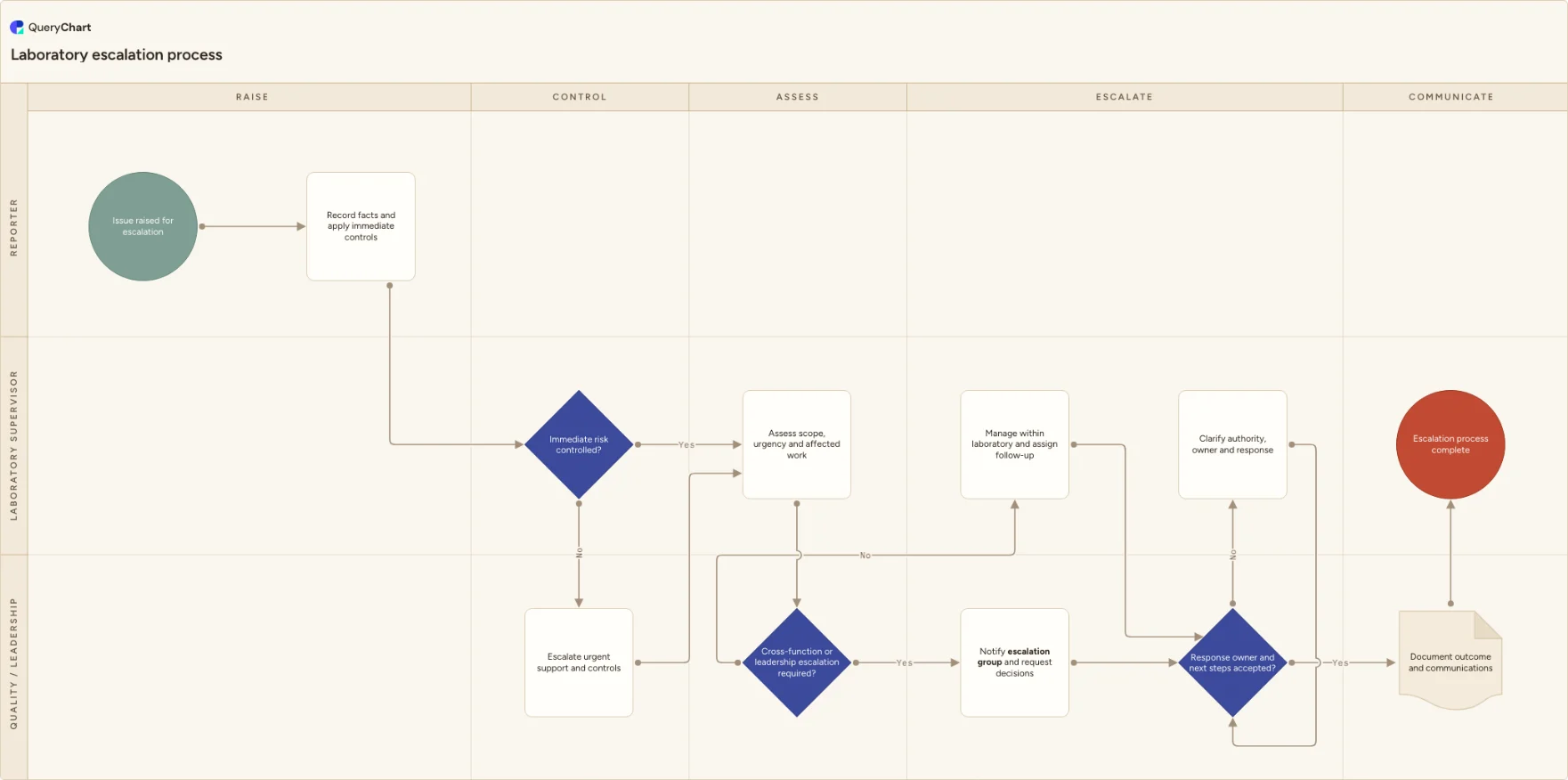
Laboratory escalation process flowchart
An editable laboratory escalation workflow for recording an issue, controlling immediate risk, assessing urgency and scope, involving leadership or specialist groups, and communicating accountable next steps.
What the laboratory escalation process is
Escalation should start with known facts and immediate controls, not a vague request for attention. The chart asks whether immediate risk is controlled and brings in urgent support when the laboratory cannot safely manage the situation with the first response.
After scope and urgency are assessed, the workflow separates a cross-functional or leadership escalation from a laboratory-managed follow-up. A final ownership decision loops unresolved authority questions back for clarification before the outcome is communicated.
Adapt escalation criteria, contacts, authority levels and communication records to the risks and governance structure at your site. The template does not set universal reporting thresholds or response times.
What this flowchart covers
In this template
- A reporter records the issue and applies immediate controls before escalation assessment.
- An uncontrolled immediate risk routes to urgent support and stronger controls.
- A supervisor distinguishes a laboratory-managed follow-up from cross-functional or leadership escalation.
- The outcome is recorded only after a response owner and next steps are accepted.
When to use this template
- You need a common path for laboratory issues that may need authority, resources or expertise beyond the local team.
- Teams currently escalate through informal messages without a shared record of risk, owner and requested decision.
- You want a reusable escalation map that can connect incidents, deviations, quality events or operational concerns to the right governance route.
How it works
Define escalation triggers
Use the risk, scope, resource and authority factors that matter at your site rather than embedding generic severity categories in the chart.
Name decision groups
Replace the general escalation group with the leaders, specialists or governance forums that can make decisions for each issue family.
Make ownership explicit
Specify the record that captures the response owner, decisions, communications and next review so a handoff does not end at notification.
Frequently asked questions
What does a laboratory escalation process flowchart cover?
It covers issue intake, immediate controls, assessment of urgency and scope, routing to laboratory or cross-functional response, confirming accountable ownership, and recording the communicated outcome.
Why assess immediate risk before deciding who to escalate to?
The laboratory may need urgent support or stronger controls before the full governance route is clear. Separating the decisions keeps immediate protection from being delayed by an administrative escalation.
Does every issue need leadership escalation?
No. The appropriate route depends on the issue, risk, scope and local authority. The template retains a laboratory-managed path while making cross-functional or leadership involvement visible when required.