SOP version control best practices
SOP version control best practices beyond generic document control: gate safety-critical revisions behind mandatory retraining, keep one owner per SOP, retire superseded copies everywhere they live, and set review intervals by risk.
SOP version control best practices are the disciplines specific to standard operating procedures (a retraining gate on safety-critical revisions, one accountable owner for the SOP itself, withdrawal from every point of use, and review intervals set by operational risk) layered on top of general document version control.
The short version
- Gate a safety-critical revision behind hands-on retraining and a signed competency check, not a read-and-acknowledge; see /templates/sop-change-control-process.
- Name one accountable owner for the SOP itself, independent of who drafted the latest revision.
- Withdraw a superseded SOP from every point of use (workstation binders, noticeboards, shared drives) not only the register.
- Set the review interval by operational risk, not a flat annual date applied to every SOP alike.
- QueryChart's Change Log and Compare Versions view, at /features/version-control, gives you the who-changed-what-field evidence without extra process.
Four disciplines a generic checklist skips
This page assumes the mechanics are already running. If your revision history log still needs a workflow (who drafts an entry, who reviews it, who signs off) that is covered at /guides/how-to-track-changes-in-an-sop, and the cadence that keeps entries moving on schedule is at /guides/how-to-manage-sop-revisions. What neither of those pages asks is whether the practice is any good once it is running, and for an SOP specifically, "good" means something narrower than it does for a policy or a spreadsheet template.
/guides/document-version-control-best-practices covers the general discipline (a stable identifier, one authoritative location, a review interval with a named owner) and every one of those rules still applies to an SOP. What is additional is that an SOP tells someone how to physically perform a task, so a revision that changes the procedure changes what a person does with their hands, not just what a file says. Four practices follow from that difference, and a generic document checklist has no reason to mention any of them: a competency gate before a safety-critical revision goes live, ownership pinned to the SOP rather than to whoever drafted it last, withdrawal that reaches the workstation and not only the register, and a review interval set by risk instead of a flat calendar date.
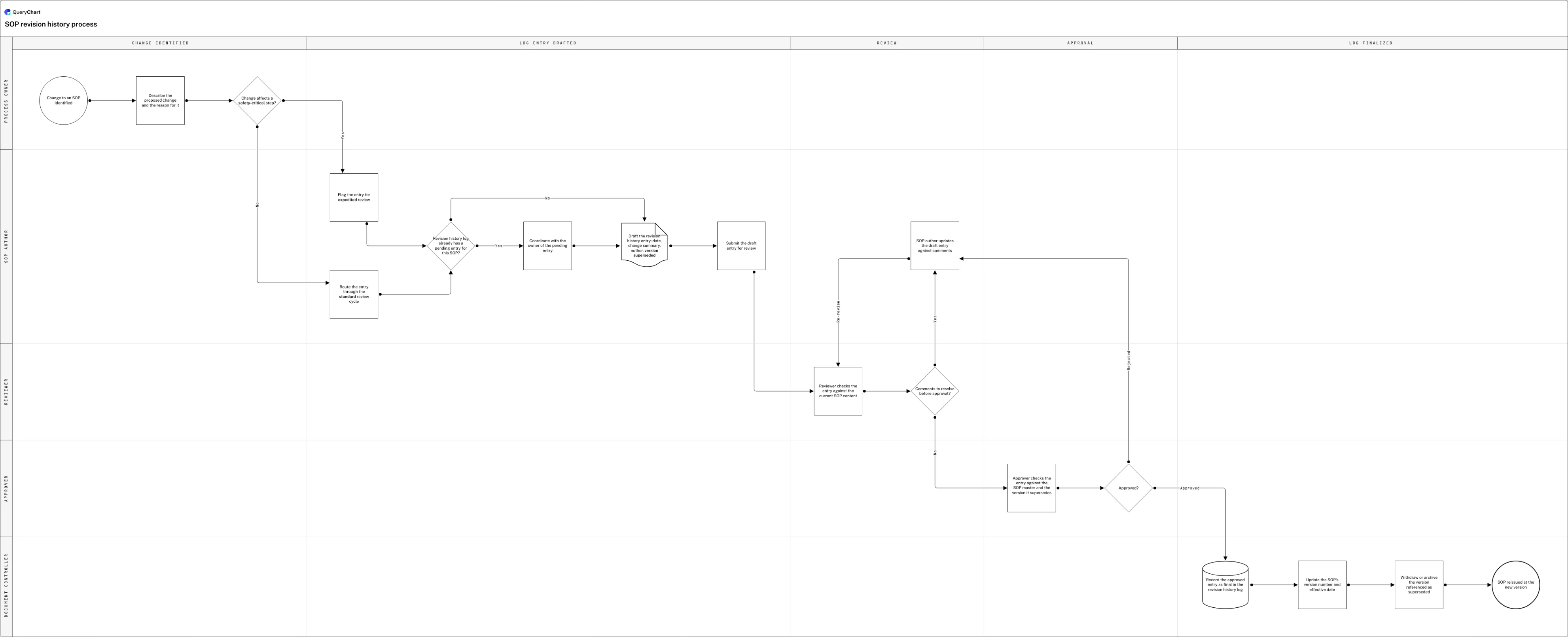
Three of the four show up directly in the revision history log walked through below: a safety-critical branch that routes some entries differently from others, a check for a duplicate entry already open on the same SOP, and a withdrawal step that has to reach the copy in use, not only the log. The fourth (one accountable owner) is a rule about who is named on the record rather than something a chart shape enforces. QueryChart's own version history gives a document controller the same kind of evidence for the chart itself: a Change Log with per-field diffs, a Compare Versions view, and one-click restore, all free and on by default, described in full at /features/version-control.
Where the practices show up in a real log
The same 18-row revision history log two earlier guides walked through, read here for what it gets right about ownership, routing, and withdrawal.
The owner flags risk before anyone drafts
The Start row is an occurrence ("Change to an SOP identified") and the Process owner lane describes the change and its reason before the Decision row "Change affects a safety-critical step?" sends it down one of two routes.
One entry per SOP, not one per editor
"Revision history log already has a pending entry for this SOP?" checks for a duplicate in flight, and "Coordinate with the owner of the pending entry" merges or sequences it rather than letting two open entries produce two candidate version numbers.
Review and approval check the entry, not just the draft
The Approver's row checks the entry "against the SOP master and the version it supersedes," not the draft alone, and a rejected "Approved?" branch returns to the same rework row a reviewer's open comment would use.
Lock it, then withdraw it everywhere
"Record the approved entry as final" locks the date, approver name and version numbers so the row cannot be silently rewritten, then "Withdraw or archive the version referenced as superseded" has to reach the printed copy at the workstation, not only this log entry, before the SOP is reissued.
How it works
Add a retraining gate to safety-critical revisions
Route any revision that touches a safety-critical step to hands-on retraining and a signed competency checklist before it goes live, not a read-and-acknowledge. /templates/sop-change-control-process shows the gate as a QA-approval branch that blocks go-live until every affected operator has signed off.
Name one accountable owner per SOP
Put the owner's name on the SOP record itself, in a field separate from the author of any single revision. Ownership should survive a personnel change or a drafting handoff; if the "owner" is whoever last edited the file, nobody is accountable for the document across its life.
Build a withdrawal checklist by point of use
List every place a revision reaches before you issue it (the workstation binder, the noticeboard, the shared drive, the induction pack) and check each one off when the superseded copy comes down. A register entry marked "withdrawn" with a printed copy still on the wall has not been withdrawn.
Tier review intervals by risk, not a flat calendar
Give a safety-critical SOP a shorter interval than a low-risk administrative one; stamping every document with the same annual date turns review into a formality nobody has time to do properly. Set the interval when the SOP is issued, not when the register happens to flag it.
Prove the practice with the Change Log, not the register alone
Open Compare Versions on the chart to see exactly which field changed, from what value, and who approved it, instead of relying on the revision history log's own account of itself. QueryChart keeps this free version history on every chart: see /features/version-control.
Mistakes to avoid
A signature that proves nothing
A read-and-acknowledge receipt proves someone opened the file, not that they can perform the new method correctly. Reserve it for low-risk changes and require hands-on retraining with a signed checklist wherever the step is safety-critical.
Ownership that changes with every edit
If accountability defaults to whoever last touched the draft, a departing author leaves the SOP with no owner at all. Assign the owner role once, on the SOP, and update it deliberately rather than letting authorship drift into it.
Withdrawn in the register, live on the wall
Marking a revision superseded in the log does nothing to the laminated copy taped up at the workstation. Walk your own withdrawal list before you trust it: the copies you find are the ones the process missed.
One interval for every SOP regardless of risk
A flat annual review date turns high-risk SOPs into low-priority paperwork and low-risk ones into wasted review capacity. Tier the interval by what the SOP governs, not by when it happens to fall due.
Related QueryChart feature
Build your own SOP revision history log
Open the SOP revision history example as your own chart and adapt the safety-critical branch, the owner field, and the review interval to your own SOPs.
Related guides
Frequently asked questions
Is SOP version control different from generic document version control?
The mechanics are the same (a stable identifier, one authoritative copy, a review interval) and /guides/document-version-control-best-practices covers them. What differs is the consequence of a gap: an SOP tells someone how to physically perform a task, so a stale or unwithdrawn copy changes what a person actually does, which is why SOP practice adds a retraining gate and a point-of-use withdrawal check that a policy or a form does not need.
When does a revision need retraining instead of a read-and-acknowledge?
When the change affects a safety-critical step: anything where doing it the old way causes injury, a nonconforming product or a regulatory breach. /templates/sop-change-control-process routes that case through a QA-gated approval and mandatory hands-on retraining with a signed competency checklist; everything else can go through the lighter read-and-acknowledge track.
Should the SOP owner and the SOP author be the same person?
Not necessarily, and keeping them separate is usually the more durable arrangement. The author drafts a given revision; the owner is accountable for the SOP across every revision it will ever have, including ones drafted by someone else after the original author has moved on.
Is SOP version control the same thing as SOP change control?
No. Version control is how you identify and track revisions; change control is the workflow gate a proposed change passes through before it becomes one. /guides/version-control-vs-change-control covers the general distinction, and for SOPs specifically, /templates/sop-change-control-process is the change-control gate that produces the version this page's practices then govern.